Ishtartv.com/Al-Najaf News
Translated
by:Aziz Emmanuel Zebari
The
directorate of Antiquities and Heritage in the governorate of Al-Najaf
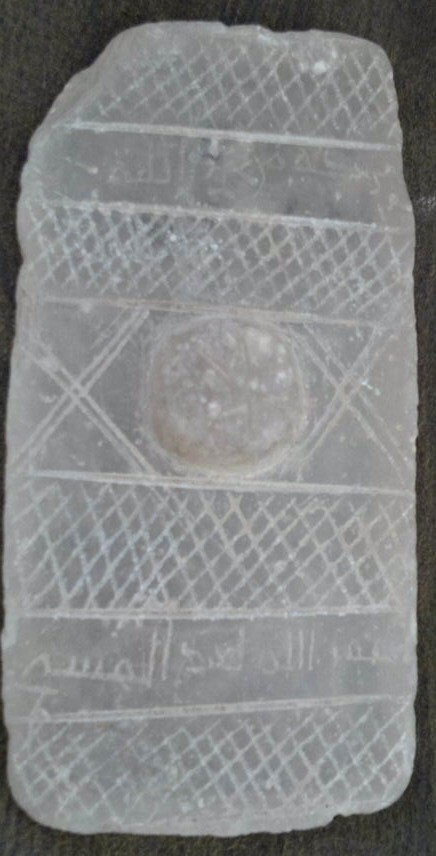
unearthed a 1700-year old monastery built before Islam belonging to the
Christian monk Abdul-Massih Ben-Bqila whose gravestone found in the church is
inscribed with the words in Kufig script “ May God Have Mercy On Abdul-Masih”
“Ancient
Hira used to be a Christian city and place of worship. Its vicinity and
outskirts are littered with churches and monasteries. We found a important
document confirming that the newly discovered church belongs to Abdul-Masih
Ben-Bqila on finding a gravestone inscribed with an old script. This is a
significant material evidence”, the Director General of Antiquities and
Heritage Muhammed Al-Mayali told Najaf News Agency.
“Abdul-Masih
Ben-Bqila used to be one of the Christian notables, and therefore some texts
say he lived for 300 years and remained Christian after Islam. He reached a
peace agreement with Khaliph Khalid Bnul-Walid when Islam was introduced in 14th century Hijra
(Islamic era). He lived long enough to see Indian and Chinese ships sailing in Al-Najaf
Sea”, he explained.
“
Abdul-Masih is the nephew of Priest Satih who the Persian king had sent to
Satih for the vision he had seen”, he added.
“The
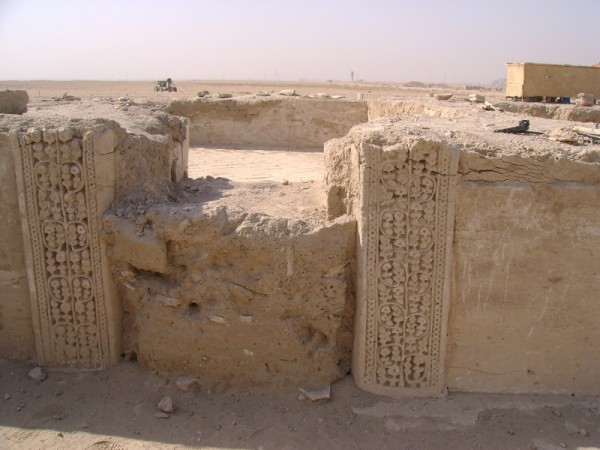
church we found in the governorate during the archaeological excavations near
the historical city of Kufa, goes back to the time before Islam”, said
archaeologist Shakir Abdul-Zahra, from the directorate general of antiquities
and heritage of Najaf, in a statement to Al-Najaf News Agency.
Abdul-Zahrah
added that the church has an area of 60X60 m and its total area is about
3600sqm. It contains four big halls, lighting rooms and sleeping rooms for the
monks. It has also annexes for services, two kitchens, and two 12X12m yards
whose area is 112sqm.
“
The church is one compound with two adjacent gates to the west, with each door
leading to a section of the church. The two gates are built in a solid and
fortified way and safeguarded in a precautionary manner to fend off any attack
by enemies”.
“The
Christian church found is surrounded by a 1.5m wide great wall built of adobe
and brick, pierced by towers. The church lies in a desert area”, he added.
In
historical reference to monk Abdul-Masih, Al-Asfahani in his “ Al-Diyarat
(Monasteries), says: “the monastery of Abdul-Masih was built by Abdul-Masih ben
Amru ben Bqila Al Ghassani in Hira.”. He added that Abdul-Masih lived as long
as 350years and the monastery was in the outskirts of Hira in a place called
Al-Jar’a and it was he who met Khalid bnul-Waleed. When he fought the Persians
on their invasion of Al-Hira, they threw him down from the towers. He used to
appear before horses which ran away in fear. And here Dharrar Bnul-Azwar said
to him (Khalid): this is due to their cheats and tricks, and so Khalid sent out
a messenger to summon a wise man from them, and Abdul-Masih Ben Amru came and
had a famous encounter with him. He said that After reconciliation with the
Muslims, Abdul Masih remained in that Monastery till his death and the
monastery fell into ruin after a while whereby a vaulted structure appeared which
was thought to be a treasure, but on opening it a marble bed was found with a
dead man on it on whose head side a small slab was found with the inscription:
I am Abdul-Masih Ben Amru Ben Bqila:
I
have experienced all ages and shared them my life
And abundance
of hopes have I realized
I
struggled against the tides of life and so did they
But
never did I succumb to difficult plights
And
in dignity I almost went as high as the Pleiades,
But
there is no way to immortality.
In
his Diyarat (Monasteries), Shabeshti tells the story of the dialogue between
Khalid Bnul-Walid and Abdul-Masih: “ When Khalid Bnul-Walid came to Hira, Abdul
Masih went out to meet him:
-
Where do I trace you back? Asked Khalid,
- To
my father, answered Abdul-Masih,
- It
wasn’t this that I asked you about!
-
Nor did I answer what you did not ask!
-
Who are you ? asked Khalid,
-Arabs,
so tell me our genealogy if you can!, said Abdul-Masih,
-
And why all these fortifications? Asked Khalid.
- We
built them as a precaution against the unenlightened till a wise comes to
restrain them!”
|