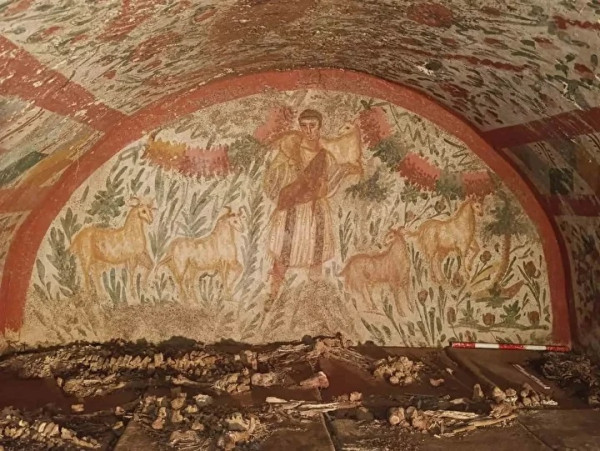
The newly uncovered fresco appears on the north wall of a hypogeum, an underground chamber tomb dating to the 3rd century AD. Credit: Arkeoloji Haber
Ishtartv.com - arkeonews.net
12 December 2025
Archaeologists in Türkiye have uncovered a remarkable Early
Christian fresco depicting the ‘Good Shepherd Jesus’, a motif rarely found
in Anatolia and possibly the only known example of its kind in the region. The
discovery was made during ongoing excavations at the Hisardere (also known as
Hisartepe) Necropolis in the Iznik district of Bursa. Experts say the find
holds exceptional significance for both Turkish and global archaeology.
The excavation team, working with permission from the Turkish Ministry
of Culture and Tourism, is led by Tolga Koparal, Director of the Iznik Museum.
Scientific coordination is provided by Prof. Dr. Aygün Ekin Meriç of Dokuz
Eylül University, with archaeologist Dr. Gülşen Kutbay contributing to the
fieldwork. Their discoveries continue to shed new light on Iznik—known in
antiquity as Nicaea, an important center of Early Christianity.
A Rare Fresco in a Well-Preserved Hypogeum Tomb
The newly uncovered fresco appears on the north wall of a hypogeum, an
underground chamber tomb dating to the 3rd century AD. Although the southern
wall of the structure has suffered heavy damage, the east, west, and north
walls—along with the ceiling—survive in almost perfect condition, giving
archaeologists a rare opportunity to study late Roman funerary art in situ.
The tomb’s interior included a kline, a funerary bed made of square
terracotta plaques upon which the deceased were placed. Directly behind this
kline is the extraordinary depiction of Jesus as the Good Shepherd,
shown in a youthful form carrying a sheep over his shoulders. This symbolic
representation is common in the Mediterranean world during the earliest
centuries of Christianity, but almost never found in Anatolia, making this example
especially valuable.
Hisartepe Necropolis: A Multi-Layered Landscape of the Dead
The Hisartepe (Hisardere) Necropolis, located just outside İznik’s
ancient fortifications, has long been known as one of the region’s largest
burial grounds. Used between the 2nd and 5th centuries AD, the area features a
wide range of burial types, including terracotta-roofed chamber tombs unique to
İznik, stone sarcophagi, simple cist graves formed with upright slabs, and
large underground chamber tombs (hypogea) carved into the earth.
These burials were used not only by elite families but also by
lower-income groups, demonstrating the social diversity of İznik during the
Roman and Early Christian periods.
Excavations in Hisartepe have previously revealed coins, ceramics, and
decorative architectural elements, but figural Christian art had never been
found here before. This makes the Good Shepherd fresco the first depiction of
Jesus ever discovered at this necropolis.
Why the Good Shepherd Image Matters
Before the widespread adoption of the cross as Christianity’s universal
symbol, the Good Shepherd motif played a key role in expressing early
believers’ faith. Depicting Jesus as a shepherd carrying a lost or rescued
sheep symbolized protection, salvation, and divine guidance. It also conveyed
Christian beliefs subtly at a time when overt religious symbolism was still
rare.
While Good Shepherd images are known from Roman catacombs in Italy, from
North Africa, and from a few sites in the eastern Mediterranean, Anatolian
examples are scarce. This rarity makes the İznik fresco a groundbreaking
addition to the region’s Early Christian artistic record.
Other Early Christian Depictions of Jesus Found in Anatolia
Although depictions of Jesus in Anatolia are not abundant before the 4th
century, several important examples exist:
Cappadocia Rock Churches (Nevşehir): From the 9th–11th centuries,
later than the İznik example, these include wall paintings of Christ
Pantocrator and biblical scenes.
Aphrodisias (Aydın): Excavations at the bishop’s palace and
basilica have revealed early Christian symbols, though few portrayals of Jesus
himself.
Ephesus (Izmir): The Cave of the Seven Sleepers and various
necropolis contexts contain Christian inscriptions and symbols, but Jesus
figures remain extremely rare.
Side (Antalya) and Sardis (Manisa): Early basilicas produced
fragments of Christian art, again with limited direct depictions of Christ.
Compared to these sites, the Good Shepherd fresco from Iznik stands out
for its age, preservation, and unique iconography, making it one of the
earliest known visual representations of Jesus in the region.
A Discovery with Global Significance
Archaeologists believe the newly uncovered fresco will contribute
significantly to the study of Early Christian iconography, Roman-period burial
practices, and the spread of Christianity in Anatolia. The find also
strengthens İznik’s reputation as a key religious and historical center,
already known for hosting the First Council of Nicaea in 325 AD, which shaped
foundational Christian doctrines.
As excavation continues, researchers hope that the Hisartepe Necropolis
may reveal additional frescoes, inscriptions, or artifacts that could further
illuminate the multicultural and religious history of ancient Nicaea.
|