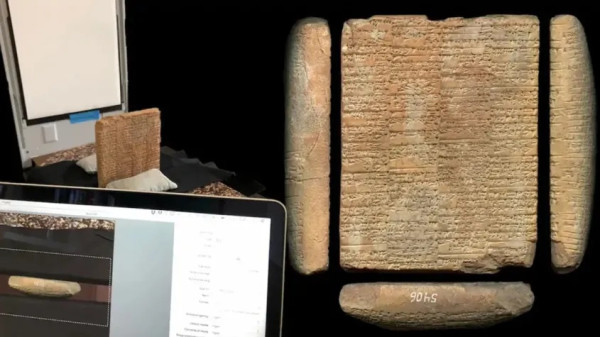
Image: Assyriologist Troels Pank Arbøll
Ishtartv.com - syriacpress.com
18/04/2026
DENMARK — Under the title “Hidden
Treasures: The National Museum’s Collection of Cuneiform Tablets,” researchers
from the National Museum of Denmark and the University of Copenhagen have begun
assembling a vast collection of inscribed clay tablets from the earliest
civilizations of the ancient Near East. Following extensive study, the team has
successfully analyzed, identified, and fully digitized this documentary corpus.
The tablets contain texts written
in cuneiform script, many of which date back more than 4,000 years. They
include anti-witchcraft rituals intended to protect Assyrian kings, poetic beer
receipts, and dynastic lists referencing the legendary king Gilgamesh, LBV
Magazine reports.
According to researcher Troels
Pank Arbøll, the collection had remained neglected in museum storage for over a
century. However, the application of digital methods and linguistic research
has enabled Assyriologists to classify a diverse range of documents, including
accounting records, letters, medical treatments, and a series of historically
significant magical incantations.
A small yet highly important
subset of the tablets originates from the Syrian city of Hemto (Hama), which
was a focal point of a Danish expedition in the 1930s. The city was destroyed
and looted in 720 BC by Assyrian warriors, who transported the spoils to their
capital, Ashur, in present-day Iraq. During their withdrawal, some clay tablets
were left behind, later becoming part of the Nordic museum’s collection.
Archaeologists believe that these
tablets were once part of a vast temple library. Assyriologist Arbøll explained
that all other texts from the collection have completely disappeared,
underscoring the exceptional nature of these discoveries, as virtually no other
cuneiform tablets addressing such subjects have been found in the region.
Among the texts from the city of
Hemto, one in particular drew the researchers’ attention. It contains an
anti-witchcraft ritual of major importance to royal authority in Assyria, due
to its perceived power to ward off misfortune, including political unrest that
could threaten the king.
The ritual was reportedly
performed over the course of an entire night and involved burning small
figurines made of wax and clay, while an exorcist recited a fixed sequence of
incantations. Researchers were surprised to find such a text far from the center
of the Assyrian Empire and the culturally rich hubs of Babylonia, given that
Hemto lay on the periphery of these regions.
In addition to the incantations,
the collection also revealed a discovery of both historical and mythological
significance. Researchers identified a copy of a well-known royal list, a
first-rate political document that records both legendary and historical kings,
some of whom are said to have ruled before the time of Noah and the Flood.
The tablet housed at the National
Museum of Denmark is an educational text listing kings who ruled at the end of
the third millennium BC. Other versions of this list include Gilgamesh, the
hero of the famous Epic of Gilgamesh. As such, the list is considered one of
the few sources suggesting that Gilgamesh may have existed as a real historical
figure. Commenting on the discovery, Assyriologist Arbøll said: “We had no idea
that we possessed a copy of that list here in Denmark. It is quite
spectacular.”
Another group of analyzed texts
originates from Danish excavations conducted in 1957 at the site of Tell
Shemshara, in present-day northern Iraq. These tablets consist of
correspondence between a local chief and an Assyrian king dating to around 1800
BC, in addition to a collection of administrative records.
Arbøll also noted that a large
number of the cuneiform tablets preserved today testify to the existence of a
sophisticated administrative apparatus, one that was essential for governing
the advanced urban societies that were emerging at the time.
|