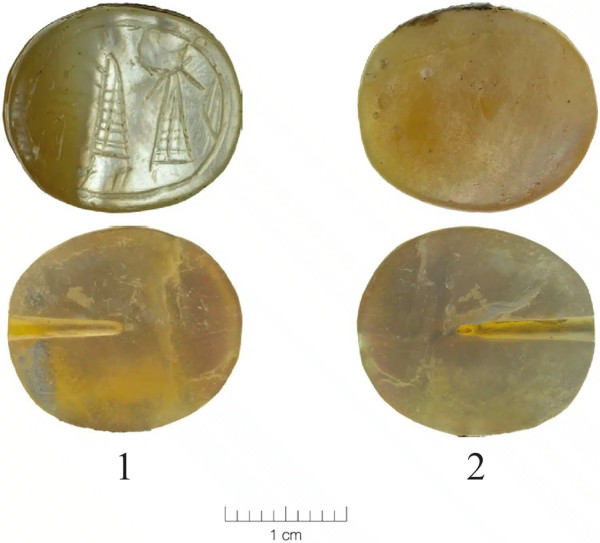
Stamp seal from Tel Hadid made of a nacreous mollusc. Credit: Ido Koch / CC BY-NC-ND 4.0
Ishtartv.com- greekreporter.com
ByNisha Zahid, June 18, 2026
A rare stamp seal carved from mother-of-pearl is offering new insight
into life in the ancient Land of Israel during the Assyrian period, according
to a study published in the journal Levant.
Archaeologists discovered the artifact at Tel Hadid in central Israel.
This site became part of the Neo-Assyrian Empire after the kingdom’s
conquest of Israel in the late eighth century B.C.
A rare find from a distant ocean
The small oval-shaped seal stands out because it was crafted from
mother-of-pearl, the iridescent inner layer of certain mollusk shells.
Researchers identified the material as coming from Pinctada margaritifera, or
the black-lipped pearl oyster, a species native to the Indo-Pacific region
thousands of kilometers from Israel.
The seal was uncovered in 2019 inside a rock-cut refuse pit
containing Iron Age pottery, animal bones, and other discarded materials.
Although the artifact was broken into two pieces, its shimmering surface
immediately caught researchers’ attention.
Researchers say no other stamp seal made from mother-of-pearl has been
documented in the archaeological record of the southern Levant.
“To the best of our knowledge… this is the only known stamp seal from
the southern Levant produced from this material,” wrote study author Ido Koch
of Tel Aviv University.
Symbols linked to an Assyrian deity
The seal’s imagery may be just as significant as the material from which
it was made.
Researchers believe the engraved design depicts symbols associated with
the moon god of Harran, a deity whose worship originated in northern
Mesopotamia. Similar imagery appeared widely across the Neo-Assyrian Empire
during the eighth and seventh centuries B.C.
The emblem typically features a crescent mounted on a pole or ceremonial
standard. On the Tel Hadid seal, a triangular figure may represent a worshiper
facing the symbol, while another shape may depict an altar or ritual
object.
The imagery suggests the owner was familiar with cultural traditions
that spread throughout the Assyrian world.
Evidence of an amulet rather than a seal
Microscopic and chemical analyses indicate that the seal was likely
engraved using a bronze tool. Researchers also found a carefully drilled hole
running through its center. The perforation was made from both ends and aligned
almost perfectly in the middle.
That feature suggests the object was intended to be worn rather than
used primarily for administration. “Most stamps of this sort functioned as
amulets in antiquity,” Koch said. “It’s kind of like wearing a pendant today.”
Researchers cannot determine where the seal was produced. It may have
been imported as a finished object, crafted locally from imported material, or
engraved in the region using a prepared shell blank.
A glimpse into life under Assyrian rule
Regardless of its place of manufacture, the artifact highlights the
cultural changes that followed the Assyrian conquest of the Kingdom of Israel.
According to the biblical account in 2 Kings 17, Assyrian king Sargon II
deported much of the local population after conquering the northern kingdom in
722 B.C. and resettled people from other regions of the empire.
Archaeological evidence from Tel Hadid points to Assyrian influence in
the area. Previous excavations uncovered cuneiform tablets documenting economic
transactions conducted under Assyrian administrative practices.
Researchers say the seal may have belonged either to a migrant from
another part of the empire or to a resident who adopted Assyrian religious
imagery. While its exact origins remain uncertain, the artifact reflects a
society shaped by migration, imperial rule, and cultural exchange more than
2,600 years ago.
|