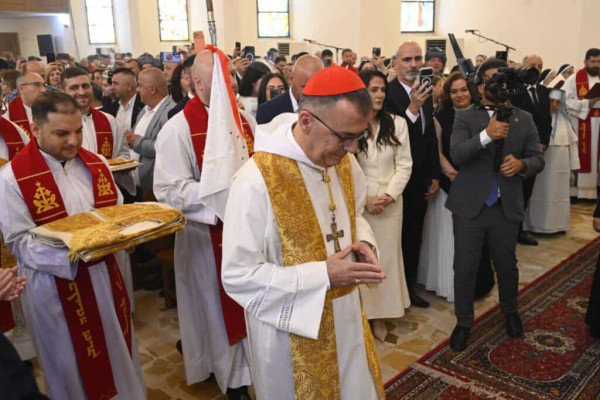
Patriarch Paul Nona at his enthronement at St. Joseph’s Cathedral in Baghdad May 29. Copyright: Aid to the Church in Need.
Ishtartv.com – churchinneed.org
John BurgerJuly 21,
2026
Head of the Chaldean Church reveals what he discussed in recent meeting
with Iraq’s prime minister.
Eleven years after jihadists forced him to leave his homeland, the
newly-elected Patriarch of the Chaldean Church heard a promise directly from
Iraq’s prime minister: Iraqis who choose to return to the country will receive
the gift of a new home and land.
Patriarch Paul III Nona of Baghdad met recently with Iraqi Prime
Minister Ali Falih al Zaidi, and the churchman was struck by the fact that al
Zaidi is a businessman first and a politician second.
“He insists that a good environment starts with a good economy. If we
have a good economy, if people feel safe to work and trust in their future,
they will come back,” the patriarch said.
The prime minister said that up to 1 million families who want to return
to Iraq from the diaspora – including Christians – will be eligible for a land
grant and new home.
There might then be some hope for Iraq’s struggling Christian community,
whose numbers are a fraction of what they were a quarter century ago, and who
face continual pressures to emigrate from their historic homeland.
In fact, Patriarch Paul said, the prime minister wants to see investment
in Iraq from Christian Iraqis who are willing to return from the diaspora. “If
Chaldeans come back as investors, they will create opportunities for other
people,” the patriarch told al Zaidi.
Patriarch Paul spoke recently with Robert Royal, special advisor to the
board of Aid to the Church in Need-USA on the matter of Christian
persecution, in the latest edition of the “Faith Under Siege” podcast. In the podcast, Paul touches on his experience as archbishop
of Mosul, which he was forced to abandon with the invasion of the Islamic State
group in 2014.
“They don’t want us to live our faith. They said openly that if you
don’t convert to Islam, we will kill you – or you have to leave. They told me
that personally in 2014, and they asked me to announce that to all the
Christians,” he recounted. “We don’t leave our faith for any reason. Therefore,
they went into the diaspora.”
Paul, who was known at the time as Archbishop Amel Nona, was later
elected Eparch of Sydney, Australia. He served there until his April 12
election to succeed Patriarch Louis Raphael I Sako.
The situation in Iraq is much better since the defeat of ISIS in 2017,
and there is no current threat from any extremist groups, the patriarch
acknowledged. But there are still challenges for the Christian community, which
he discussed with Prime Minister Al Zaidi earlier this month.
“The people who left Iraq don’t have trust in this country; they don’t
have trust in their neighbors, after the experience with ISIS,” he said. “I
told the prime minister that we have to create a safe environment for people to
come back, first to find a good opportunity for them to work and to live, and
also to have a trust in their future.”
Christians face more difficulties in the countryside, where historically
many of the villages were Christian, than in cities such as Baghdad or Mosul,
he said.
The patriarch, 58, who was enthroned in Baghdad’s St. Joseph
Cathedral on May 29, commented on Aid to the Church in Need’s work in Iraq,
saying it has included the financial support of several projects and ongoing
scholarship for university and high school students. Having children who are
studying in Iraq is the kind of thing that keeps families in their homeland.
The pontifical foundation also has supported seminaries and catechetical
programs in Iraq.
“I believe what Church in Need did, and are still doing, is essential
for our people, for our community to remain and continue their journey of
faith,” he said.
The patriarch also called on Catholics to better inform themselves and
“know our situation, not from the media but from real sources. the situation of
Christians in Iraq and in the Middle East is different from what the media say.
Sometimes the big media focus on small things that don’t really affect our real
life.”
That advice would apply to governments as well as individuals, he said.
“Put pressure on [Western] governments to understand the situation of
Christians in the Middle East before [taking] any action,” he requested of
Christians in the West.
Said the patriarch, “Sometimes in the West they don’t understand exactly
what’s happening here, how our life is in this region.”
|