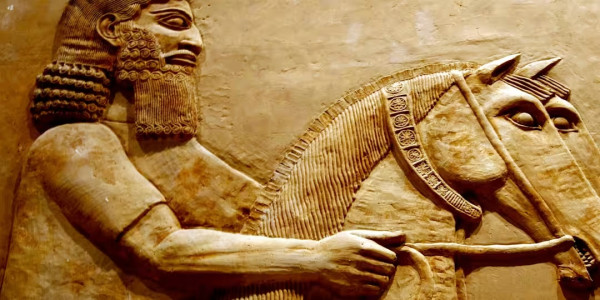
An Assyrian mural depicting a king in his chariot on display at the Iraqi Museum. AFP via Getty Images
Ishtartv.com - history.com
Tom Metcalfe, August 05, 2026
From 912 to 609 B.C., this empire
became the largest the ancient Near East had ever seen.
More than 2,500 years after the
fall of the Assyrian Empire, archaeological discoveries continue to reveal new
details about its powerful kings and the grandeur of its capital. In July 2026,
a rare, well-preserved inscription stone was unearthed in Iraq detailing the
achievements of the powerful Assyrian king Ashurbanipal. It was found amid the
ruins beneath the modern Iraqi city of Mosul, which was built atop the
Neo-Assyrian capital of Nineveh. The find followed the discovery of the names
of three previously unknown Assyrian kings, further deepening historians’
understanding of the empire.
Here’s what made the Assyrians so
dominant in ancient Mesopotamia.
1. They had a strong military.
The Assyrian military transformed
Assyria into the world’s first military superpower. Its power peaked during the
empire's Neo-Assyrian phase, between 911 and 609 B.C., largely thanks to the
reforms of King Tiglath-Pileser III, who established the first professional
standing army around 745 B.C. This move allowed for year-round campaigning.
The Assyrian military also
developed a knee-high heavy military boot for harsh terrain and was the first
to equip its soldiers with iron weapons, giving them a decisive edge over
armies still using more expensive bronze weapons. The Assyrians organized their
armies into infantry, cavalry and missile units—archers and slingers—and
mastered siege warfare against fortified enemy cities. The Assyrian military
was also expert at spreading systematic terror, mass deportations and other
forms of psychological warfare, tactics that later influenced military powers
including the Romans.
2. They benefitted from
innovation.
The Assyrians absorbed and built
on earlier Mesopotamian achievements, beginning with the Sumerians around 5000
B.C. By the time of the Neo-Assyrian Empire, which emerged in the 10th century
B.C., the Assyrians had adopted many key innovations from their predecessors,
including writing, mathematics, engineering and complex legal codes.
The Library of Ashurbanipal,
which archaeologists discovered in the 19th century at Nineveh, near modern-day
Mosul, contained thousands of texts that had been systematically collected,
translated and copied from across Mesopotamia, including the Epic of Gilgamesh—an
epic poem dating to roughly 2100 B.C. that tells the story of an earlier
Sumerian king of that name. These texts were written in cuneiform on clay
tablets and can still be read today.
"We have literally tens of
thousands of texts from Assyria," says Assyriologist Eckart Frahm of Yale
University. "Fortunately for us they wrote on clay, and clay, once
sun-dried, is almost indestructible."
3. They had (a) God on their
side.
Like other Mesopotamian
civilizations, the Assyrians had a pantheon of gods with their own patron
deity, Ashur, in the top spot. The gods of conquered peoples, such as those of Babylon
or Ur, might be admitted to the Assyrian pantheon, but at a lower rank than
Ashur and the other major deities. Assyria's king styled himself as the steward
or viceroy of the chief god, and this religious unity—enforced by the
state—helped bind the Assyrian Empire together.
Assyria is the villain in parts
of the Bible, and Ashur is often presented as powerless against the Israelite
god Yahweh. A famous episode occurred when the Neo-Assyrians under King
Sennacherib besieged Jerusalem in 701 B.C., an event immortalized by Lord Byron
in his 1815 poem “The Destruction of Sennacherib”:
The Assyrian came down like the
wolf on the fold, And his cohorts were gleaming in purple and gold;
According to the Bible, a plague
sent by Yahweh struck the Assyrian army overnight, causing many soldiers to die
and the siege to be abandoned. But the plague account may be a story. Both
Assyrian records and the Bible say that Jerusalem paid a massive tribute in
gold and silver to the Assyrians, Frahm says, which may explain why the
Assyrians did not sack the city.
4. Their time had come.
The Assyrians first appeared
around 2900 B.C. as traders from the northern city of Ashur, which was named
for their chief god. Around 1800 B.C., they emerged as a regional power under
the Amorite conqueror Shamshi-Adad I.
As their kingdom expanded, the
Assyrian capital moved several times, from Ashur to Kalhu (Nimrud), then to
Dur-Sharrukin (Khorsabad). The empire reached the height of its power after 702
B.C., when King Sennacherib established a new capital at Nineveh.
The Assyrian Empire eventually
crumbled under weak rulers, and for a time Babylon was ascendant again. But the
Neo-Babylonians never equaled the power or prominence of the Neo-Assyrians.
5. Their rulers created a stable
system.
The Assyrians may have been the
greatest of Mesopotamian cultures, and their Neo-Assyrian phase represented a
high point of civilization in the ancient Near East. At its height, the
Assyrian Empire was the largest the region had ever seen, stretching from
western Iran to the Mediterranean coast and even into Egypt. Its ruling
mechanisms served as a blueprint for many ancient empires that came later,
including the Romans.
Assyria did not just conquer
Mesopotamia—it codified and archived much of its intellectual legacy. It also
appears to have overcome the typical fragility of Mesopotamian states through
firm leadership, says Assyriologist Philip Jones, a curator at the Penn Museum.
“Somehow, [Assyria] created a more stable provincial system," he says,
"where new kings did not meet automatic rebellion on their accession to
the throne."
|