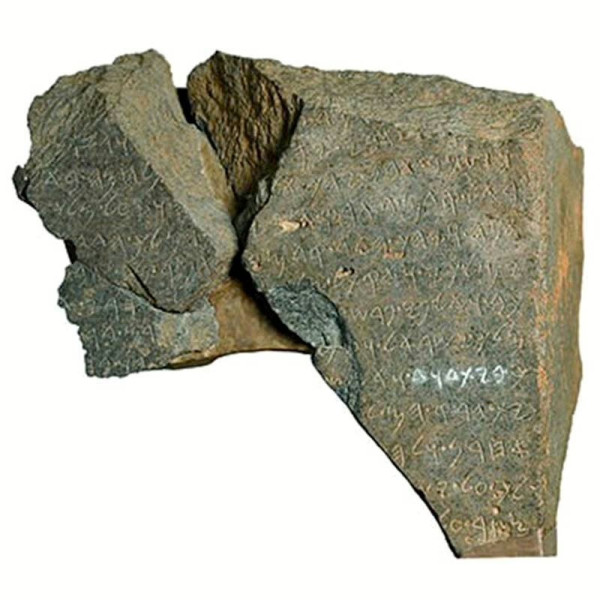
The Tel Dan inscription (Image: Meidad Suchowolski)
Ishtartv.com - the-express.com
By Emilia Randall, Aug 23,
2026
The Tel Dan inscription, or
"House of David" inscription, was unearthed in 1993 at the site of
Tel Dan in northern Israel.
A groundbreaking archaeological
discovery has dramatically reshaped our understanding of Biblical
history, widely regarded as having "proved" the authenticity of
the Bible.
The Tel Dan inscription, a
ninth-century B.C. stone slab unearthed in 1993, provided the first concrete
historical evidence of King David of the Old Testament, supporting the truth of
the Bible as a whole as well as the existence of Jesus.
Also referred to as the
"House of David" inscription, the artifact was discovered at
the Tel Dan site in northern Israel during an excavation spearheaded by Israeli
archaeologist Avraham Biran, according to Joy! News.
The partially damaged and
incomplete inscription commemorates the triumph of an Aramean king over two
neighboring southern rulers: the "king of Israel" and the "king
of the House of David.", reports the Daily Star.
In an intricately carved text
written in precise Aramaic characters, the Aramean king claims that, under the
divine guidance of the god Hadad, he defeated several thousand Israelite and
Judahite horsemen and charioteers before personally slaying both of his royal
adversaries, consistent with the Biblical account.
Unfortunately, the recovered
fragments of the "House of David" inscription failed to identify the
names of the other specific kings implicated in the conflict. Nevertheless,
most scholars believe the slab documents a military campaign by Hazael of
Damascus, in which he vanquished both Jehoram of Israel and Ahaziah of Judah.
For Christians and archaeological
scholars alike, the inscription's direct reference to the "House of
David" is what made it so compelling. The slab's fragmented inscription,
initially deciphered and translated by expert Joseph Naveh, demonstrated that
the Biblical King David was an authentic historical figure rather than a
creation of Biblical authors and editors.
Even more remarkably, the slab,
erected by one of ancient Israel's most powerful adversaries more than a
century after David's death, still recognized David as the founder of the
kingdom of Judah.
The "House of David"
inscription faced skepticism from some quarters. The so-called Biblical
minimalists dismissed the "House of David" interpretation
One prominent scholar, Philip
Davies, contended the Hebrew term bytdwd referred to a specific location
(comparable to bytlhm for Bethlehem) rather than David's ancestral dynasty.
Nevertheless, the majority of
Biblical scholars and archaeologists rapidly accepted that the Tel Dan slab had
furnished the first concrete evidence of a historical King David from the
Bible, establishing it as one of the most important Biblical archaeology
discoveries.
While the "House of
David" inscription has confirmed that the Biblical King David existed,
scholars have yet to reach consensus regarding the nature and extent of his
reign. Was David the great monarch of Biblical tradition who established his royal
capital at Jerusalem and founded an Israelite kingdom?
Were David's dominions limited to
a small, tight-knit community?
Such questions routinely surface
in the wake of Biblical archaeology discoveries, and sit at the very core of
the intricate interplay between archaeology, history, and the Bible.
|