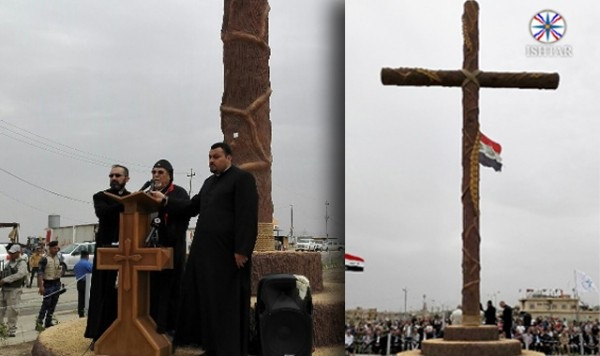
Archive photo courtesy of Ishtar TV. Residents of Baghdeda (Qaraqosh) celebrate the inauguration of the largest cross at the entrance to the city in 2017.
Ishtartv.com
Baghdad – Christian
religious and political leaders in Iraq are increasingly calling for genuine
guarantees of the rights of the Christian community, stronger political
partnership and equal citizenship, as well as the restoration of state
authority and improved security, amid a significant decline in the country’s
Christian population over the past decades.
A report published
by Coptic Solidarity on September 24, 2026, citing a report by journalist Peter
Kenny for Ecumenical News, said that Christian religious and political leaders
had called on Iraqi Prime Minister Ali Faleh Al-Zaidi to ensure genuine
political partnership for Christians, strengthen state authority, improve
security, and support the return of families who have been displaced from their
areas in recent years.
Sharp Decline in
the Christian Population
According to the
report published by Ecumenical News on September 20, citing estimates from
church sources and organizations concerned with defending Christian rights,
Iraq’s Christian population was estimated at around 1.5 million before 2003,
but has since fallen to fewer than 200,000 people.
The report said
that the decline has been linked, according to Christian leaders and
organizations monitoring the community’s situation, to waves of displacement
and emigration following wars and violence, as well as economic pressures and
inadequate protection in several areas with historically significant Christian
populations.
Calls to Create
Conditions for the Return of Displaced Christians
In remarks cited by
the report, Mar Paulus III Nona, Patriarch of the Chaldean Church in Iraq and
the World, expressed hope that conditions would improve in a way that would
allow Christians to regain confidence in their homeland and society and enable
families to return to their places of origin.
The patriarch
stressed that the coming period should witness a reverse migration, with
families returning to their original areas once the necessary conditions for a
secure and stable life are in place.
He also emphasized
that peace, coexistence, respect for human dignity, and the protection of the
legitimate rights of all components of society are fundamental pillars for
building a stable society, according to Ecumenical News.
Calls for Political
Partnership and Equal Citizenship
In the same
context, the report quoted Ano Jawhar Abdoka, Minister of Transport in the
Kurdistan Regional Government and Secretary-General of the Christian Alliance
in Iraq and the Kurdistan Region, as warning of the growing challenges facing
Christians in Iraq and the wider Middle East.
His remarks came
during the 33rd General Assembly of the Interparliamentary Assembly on
Orthodoxy in Helsinki, where he called for genuine national partnership,
meaningful reforms, equal citizenship, fair representation, and the
strengthening of the rule of law as essential elements for safeguarding the
future of Christians in Iraq.
Abdoka also called
on the Iraqi government to take decisive steps to protect Christians from the
influence of armed groups and unofficial economic offices, and to guarantee
their rights as an indigenous people of Mesopotamia, according to the report,
which cited The New Arab.
Security and
Stability as Conditions for the Continuation of Christian Presence
These demands come
amid broader calls to address the factors that have driven thousands of
Christian families to leave Iraq, including security concerns, displacement,
and economic pressures, as well as the need for genuine political
representation and equal legal protection.
The report
indicates that a number of Christian leaders believe the future of the
Christian presence in Iraq depends on the ability of state institutions to
uphold the rule of law, protect citizens, and create an environment in which
families who have left the country can reconsider returning.
The demands
therefore extend beyond temporary security measures to include political,
legal, and economic guarantees aimed at restoring Christians’ sense of security
and citizenship, while creating the conditions necessary for those who remain
to stay and for those forced to emigrate or flee to consider returning.
|