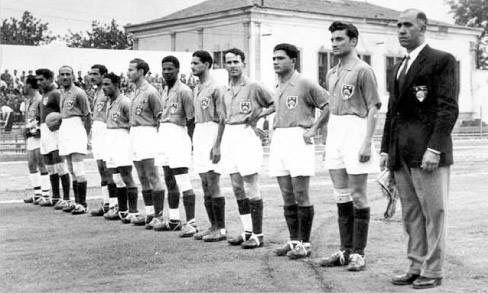
Iraq’s first historic national football team during its tour of Turkey in 1951 / Historical Wikimedia archive / Available for publication and news use under the Creative Commons Public Domain. Coach Diaa Habib; Percy Lindsell; Karim Alawi; Nasser Youssef (Nasser Jaco); Shaker Ismail; Saleh Faraj; Saeed Yeshua Murad; Hama Bashka; Jamil Abbas (Jamouli); Touma Abdul Ahad; Adel Kamel; and Wadoud Khalil Jumaa (captain).
Ishtartv.com/
BAGHDAD — Special
Report: The contribution of
Iraqi Christians to football was not a recent phenomenon associated with
professionals playing in Europe or with generations that represented Iraq in
continental and international competitions. Its roots go back to the earliest
stages of the development of Iraqi football itself, during the first half of
the 20th century.
During that period, a
number of Iraqi Christian players, particularly members of the Assyrian
community, emerged at clubs in Basra and Baghdad and around the Royal Air Force
base in Habbaniya. Some of them later went on to join the ranks of Iraq’s first
national team in the early 1950s.
According to Iraqi
football historian Hussainin Mubarak, in an account published by The
Guardian, three players were among the prominent figures who helped shape
Iraq’s first national team in 1951, including Saeed Isho and Aram
Karam, both of Christian/Assyrian background. The account also highlights
the role played by the sporting environment surrounding British air bases and
local teams in the emergence of modern Iraqi football.
Saeed Isho: A
Member of Iraq’s First National Team
Saeed Isho stands out as one of the earliest Iraqi
Christian players to wear the national team shirt.
Isho was born in Basra
in 1928. His father was a priest of the Assyrian Church of the East, and the
family had settled in the city in the early 20th century. Saeed began playing
football in Basra’s schools before joining local teams. He later played for the
Basra Petroleum Company team and also represented Al-Minaa Club.
In 1951, Isho was
called up to Iraq’s first national team squad and played in what historians
describe as the Iraqi national team’s first international match, against Turkey
B on May 6, 1951.
According to Hussainin
Mubarak’s account, Isho played in defense for the pioneering Iraqi side before
leaving Iraq a few months later to study in Britain.
His career then
entered a new phase after attracting the attention of football officials in
England. He was given an opportunity to become associated with Sheffield
United and later played for Manchester United’s reserve team during
the 1960s.
His career made Isho
one of the earliest Iraqis to combine international representation for his
country with experience in English football.
Aram Karam: The
Assyrian Forward Who Made an Early Name for Himself
Another prominent
figure from the pioneering generation was Aram Karam, an Iraqi Assyrian
player who grew up in the Habbaniya area and became known for his ability to
score from difficult distances and angles.
Karam belonged to a
generation that played football in the environment surrounding the British air
bases. He represented several teams before joining sides associated with the
air force and later becoming one of the leading figures at the Assyrian Club.
Historical sources
indicate that Karam began his career with football teams connected to the air
bases in Baghdad and Habbaniya. In 1943, he played for Arsenal Sports Club
in Habbaniya, before moving between several teams and eventually joining
the Iraq Petroleum Company.
Karam became
particularly well known for his shooting and goalscoring ability. At different
stages of his career, he served as a player, forward, captain and coach.
In 1951, he belonged
to the generation associated with the formation of Iraq’s first national team
and later became one of the prominent names in Iraqi football during the 1950s.
Yura Ishaya: The
First Iraqi to Play in England
While Saeed Isho and
Aram Karam were prominent figures of the early years, Yura Ishaya holds
a special place in Iraqi football history as the first Iraqi player to play in
England.
Born in 1933 to an
Assyrian family, Yura Ishaya grew up in the Habbaniya and air-base environment,
where he began playing football at an early age.
In 1953, he attracted
the attention of a talent scout associated with Bristol Rovers and moved
to England in 1954. There, he played for the club’s third team in the Western
League, while also working in Britain.
Sources indicate that
Ishaya worked in the British coal mines in order to maintain his legal status
and residence in the country while continuing to play football.
In 1955, he returned
to Iraq after receiving an offer to return to Baghdad and play for the Iraqi
Royal Air Force.
He subsequently became
a member of the Iraqi national team and played in the historic match against
Morocco at the 1957 Arab Games in Beirut. The match marked Iraq’s first
official appearance at a major international tournament and ended in a 3-3
draw.
Ishaya scored one of
Iraq’s goals alongside Ammo Baba. Historical sources on Iraqi football
identify both Ammo Baba and Yura Ishaya as members of Iraq’s Assyrian minority.
Ammo Baba: A Name
That Transcended Community and Club
No account of the role
of Christians in the history of Iraqi football would be complete without Ammo
Baba, who later became one of the most famous figures in Iraqi football as
both a player and coach.
Born Emmanuel
Dawood, Ammo Baba was a member of the Assyrian community. He began his
sporting career at the Assyrian Club before becoming one of Iraq’s leading
players during the 1950s and 1960s.
An academic study of
the history of the Assyrian community in Iraq notes that the Assyrian Sports
Club, founded in Baghdad in 1955, became an important center for sporting
activity. Among the players who began their careers there were Ammo Baba,
Edison David and Douglas Aziz.
Ammo Baba later became
one of the pillars of the Iraqi national team and subsequently coached the
national side at several stages of his career, making him one of the most
influential figures in the history of Iraqi football.
He died in 2009 and
was buried at Baghdad’s Al-Shaab International Stadium, in an
exceptional tribute to his sporting career.
Edison David: From
the Assyrian Club to the National Team
Another member of the
early generation was Edison David, who began his sporting career in the
mid-1950s and was among the Assyrian players who played an important role in
the development of modern Iraqi football.
David was born in
1933. He began playing football at an early age with local teams before joining
Al-Quwa Al-Jawiya in 1955.
That same year, he was
selected for the Iraqi national team and continued representing the country
until 1965.
Sources indicate that
he played an important role for both the national team and Al-Quwa Al-Jawiya
and was named the best player in the Iraqi league in 1958.
An academic study of
the Assyrian Club identifies Ammo Baba, Edison David and Douglas Aziz among the
prominent players who emerged from the Assyrian sporting institution in
Baghdad.
The Assyrian Club:
A Sporting Institution That Produced a Generation of Stars
The establishment of
the Assyrian Sports Club in Baghdad in 1955 was an important milestone
in Iraqi sports history, not only in the history of Assyrian sport.
The club became a
venue for football and other sports and attracted players from the Assyrian
community, but it did not remain an institution limited to one community.
An academic study
published through Cambridge notes that the club became a center for
sports not only for Assyrians but for Iraqi sport more broadly, producing a
number of national-team players.
Among the prominent
names associated with this sporting tradition were:
- Ammo Baba
- Edison David
- Douglas Aziz
- Yura Ishaya
- Aram Karam
- Basel Gerges
- And, in later generations, other players
who became part of the history of Iraqi football.
The Assyrian Club thus
developed from a sporting institution into an important center that helped
produce generations of players and coaches whose influence on Iraqi football
continued for decades.
Douglas Aziz: From
Player to Coach
Douglas Aziz represents a later stage of this generation,
but he belonged to the same sporting tradition associated with the Assyrian
Club.
Aziz was a prominent
defender before moving into coaching. He later coached Al-Shorta Club
and led the team to the first league title in its history during the 1979-80
season, according to sources documenting the Assyrian contribution to Iraqi
football.
His career
demonstrates that the contribution of Iraqi Christians extended beyond playing
to coaching, sports administration and the development of Iraqi clubs.
From the Pioneering
Generation to the Golden Era
Over the years, the
presence of Assyrian and other Christian players became part of the broader
landscape of Iraqi football.
During the 1980s, Basel
Gerges emerged as part of Iraq’s golden generation. The Iraqi player of
Assyrian background represented the national team between 1982 and 1989 and
scored four international goals, according to available records of his career.
Gerges was part of a
national team that included major figures such as Hussein Saeed and Ahmed
Radhi, during a period widely regarded as one of the significant stages in
the development of Iraqi football.
From the Pioneers
to Iraq’s World Cup Players
This presence
continued in subsequent decades, although the number of Christian players in
the national team varied from one generation to another.
In recent years,
several players from Iraq’s Chaldean, Syriac and Assyrian communities have
appeared for the Iraqi national team, including Rebin Solaka, Frans Dhia
Jasim, Aymar Sher and Kevin Yakob, alongside other players of Iraqi
Christian heritage.
Recent reports have
documented the participation of some of these players in Iraq’s campaign toward
the 2026 FIFA World Cup, presenting their presence as part of a sporting
history that dates back to the earliest generations of Iraqi football.
Football as Part of
Iraq’s Shared History
The stories of these
players show that the participation of Iraqi Christians in football did not
begin with modern professionalism or with players born abroad. It dates back to
the earliest years when the Iraqi national team itself was taking shape.
Saeed Isho belonged to
the first generation of the national team, Aram Karam was one of the leading
forwards of that generation, while Yura Ishaya became the first Iraqi to gain
football experience in England. Ammo Baba, Edison David, Douglas Aziz and others
then continued to build on that sporting legacy.
The history of Iraqi
Christians in football therefore intersects with the history of Iraqi football
itself—from the teams of Basra and Habbaniya and the air bases, to the national
team and the Assyrian Club, and eventually to generations that represented Iraq
in continental and international competitions.
|