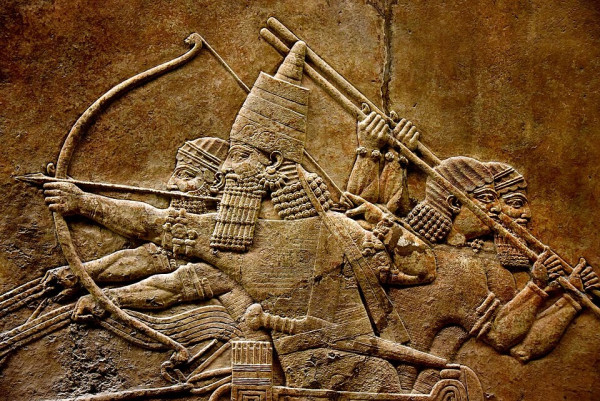
An Assyrian stone relief depicting warriors from ancient Nineveh (7th century BC) — displayed and available as Public Domain via Wikimedia Commons / The British Museum.
Ishtartv.com
BAGHDAD — News Agencies
Recent historical and climate research reveals that severe, decades-long
droughts severely strained the food supply of the Neo-Assyrian Empire. This
environmental crisis placed immense pressure on its capital, Nineveh, in the
period leading up to its historic fall in 612 BC to Babylonian and Median
forces.
According to a detailed
historical report published today by the archaeological platform Curiosmos, the findings are based
on a laboratory analysis led by scientist Ashish Sinha. The study, published in
the scientific journal Science Advances, examined mineral deposits and oxygen
isotope layers from a stalagmite inside the famous Kuna Ba Cave in northern
Iraq.
The cave’s geological record
indicates that the centuries of major Assyrian expansion were relatively wet
and favorable for agriculture. However, conditions shifted sharply during the
early to mid-seventh century BC, giving way to repeated droughts that lasted
for decades. This acute water scarcity triggered the initial decline in crop
harvests across the northern Mesopotamian heartland.
The strategic report, which
correlates with paleoclimate data from the National Oceanic and Atmospheric
Administration NOAA repository, explains that the water shortage crippled
the economic backbone of the Assyrian state. The empire relied heavily on
agricultural taxes, stable supply movements, and millions of forced laborers.
This climate stress severely weakened the royal court's capacity to fund its
armies and maintain vital foreign alliances.
Researchers emphasize that while
prolonged drought was a critical factor, it was not the sole cause of Nineveh’s
collapse. The empire was already fractured by internal political instability
and a bitter succession crisis following the death of King Ashurbanipal.
Nevertheless, the environmental data shows that severe climate stress
drastically narrowed Assyria's agricultural room to maneuver. This left the
state uniquely vulnerable and unable to absorb the consecutive military shocks
that ultimately brought down its capital.
|