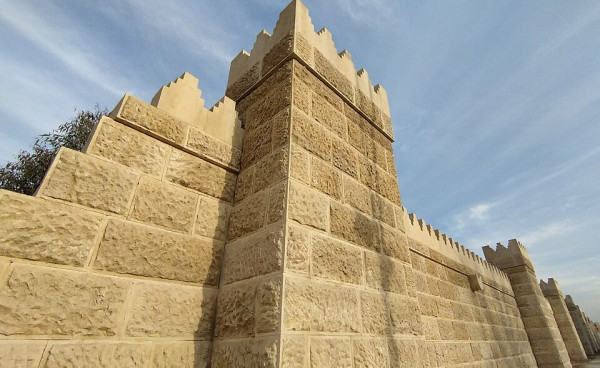
The reconstructed ancient Wall of Nineveh on the eastern side of Mosul, Iraq. Photo by Abdulsalam Al-Dabbagh / Wikimedia Commons, licensed under CC BY-SA 4.0.
ishtartv.com
Mosul – Iraq: Judicial
authorities in Nineveh Governorate have released Dr. Amer Abdullah Najam
al-Jumaili, a professor and researcher in history and archaeology at the
University of Mosul, on financial bail. The release follows the completion of
preliminary legal procedures regarding his detention, in a case that has
sparked significant debate over the protection of historical lands and
archaeological sites in the governorate.
Shafaq News reported on September
29, 2026, that the Nineveh judiciary released al-Jumaili on financial bail
after completing initial legal steps. The network quoted a security source
stating that al-Jumaili, a professor at the University of Mosul's College of
Archaeology, had been detained over Facebook comments he posted regarding
government-owned lands situated near an ancient Assyrian archaeological site in
Nineveh.
Arrest Over a Post Regarding
an Archaeological Site
A security force detained
al-Jumaili on September 28, according to statements his wife, Muna Haidar, gave
to Shafaq News. She noted that contact with her husband was abruptly lost
before she learned he had been taken to an undisclosed location at the time.
Haidar called upon the Prime Minister, as well as judicial and security
authorities, to reveal his whereabouts and intervene in the case.
According to the same source, the
detention was linked to a Facebook comment posted by al-Jumaili regarding what
was described as the seizure or utilization of protected archaeological land.
Initially, authorities had not released detailed announcements regarding the
legal status of the arrest or the entity that ordered it.
The Family: Refusal to Sign
Documents Involving Archaeological Lands
In a statement addressed to the
Iraqi Prime Minister, al-Jumaili's family stated that his arrest was also tied
to his professional stances as a judicial expert and a researcher in history
and archaeology.
According to SyriacPress,
referencing the family’s statement, al-Jumaili had refused, in his capacity as
a judicial expert, to sign official minutes regarding lands classified as
archaeological sites or protected heritage zones in Nineveh. The family claimed
these areas were under threat of being repurposed for commercial use and
demanded government intervention for his release.
However, this narrative
represents the stance of the family and solidarity groups, and these claims
have not been legally proven; full details of the charges, evidence, and
judicial proceedings have not yet been officially published in a comprehensive
manner.
University of Mosul Clarifies
Location of Arrest
Amidst the growing controversy
surrounding the case, the University of Mosul issued a clarification stating
that al-Jumaili's arrest did not take place inside the university campus. The
institution noted that the operation was carried out at a location outside the
university walls.
SyriacPress reported that the
university’s statement came in response to reports alleging that the professor
was detained inside the campus, leaving the execution site of the arrest as one
of the details officially clarified by the university.
Solidarity from Assyrian and
Syriac Quarters
The case triggered reactions from
organizations and figures within the Chaldean Syriac Assyrian community,
particularly due to its connection to the preservation of archaeological sites
in Nineveh.
SyriacPress reported that the
Syriac Writers and Literati Union expressed deep concern over the detention,
calling for a clarification of the circumstances while emphasizing respect for
the law and the independence of the judiciary. According to the report, the
Union stressed that protecting archaeological sites and lands—especially those
linked to Assyrian heritage in Nineveh—is a national and legal responsibility.
An Academic Specialized in
Ancient Iraqi History
Al-Jumaili boasts a long academic
career dedicated to studying the history and antiquities of Iraq.
According to the academic
biography published by SyriacPress, al-Jumaili earned his Master of Arts in
History from the University of Mosul in 2001, focusing his research on scribes
in ancient Mesopotamia. He later obtained his PhD from the same university in
2006 for a dissertation examining the geographical knowledge of ancient Iraqis.
Al-Jumaili serves as a professor
and lecturer in the Syriac Language Department at the College of Education for
Human Sciences at the University of Mosul. He is also affiliated with the Mosul
Studies Center and has authored research works in history, historical
geography, archaeology, manuscripts, and inscriptions.
The biography provided by the
source highlights his participation in excavations and field studies across
several archaeological sites, including Balad, Eski Mosul, Simele, and Nineveh.
Additionally, he specializes in deciphering ancient writing systems, including
Cuneiform, Aramaic, Syriac, and Hatran.
Case Extends Beyond al-Jumaili
to Heritage Protection
Al-Jumaili's arrest coincided
with another case that drew widespread attention within Iraqi archaeological
circles. The Art Newspaper, in a report published on September 29, highlighted
the detention of another Iraqi archaeologist, Ali Tabar. The outlet noted that
both cases have raised concerns among some researchers regarding how
archaeological lands and sites are handled under Iraq's investment laws.
The newspaper pointed out that
Iraqi law applies various classifications to archaeological sites, and current
discussions involve the potential reclassification of certain sites' protection
levels to allow for economic or investment utilization. The report also cited
researchers' fears that rapid archaeological surveys might overlook significant
historical sites.
However, The Art Newspaper
emphasized that the exact legal details of al-Jumaili's case remained unclear
at the time of publication, and it was unable to confirm all allegations or
determine the full legal basis for his detention.
Bail Release Opens Path for
Judicial Process
With al-Jumaili's release on
bail, the case transitions from initial detention to subsequent legal
proceedings.
Shafaq News confirmed that the
release took place after preliminary steps were concluded, with al-Jumaili
freed on financial bail. Meanwhile, the broader details of the case and the
specific charges to be pursued in the judicial track await further official
clarification.
Simultaneously, this case places
the archaeological heritage of Nineveh at the forefront of public discussion.
Since the governorate contains vital sites tied to the history of Assyria,
Nineveh, and successive civilizations, any dispute over the classification or
use of archaeological land carries a cultural and legal significance that
transcends the scope of an individual case.
While awaiting the outcomes of
the judicial process, the latest verified facts confirm that al-Jumaili was
detained on September 28 over a case involving comments and stances on
archaeological lands, and was subsequently released on bail on September 29,
while the full legal basis of the case is still being clarified.
|