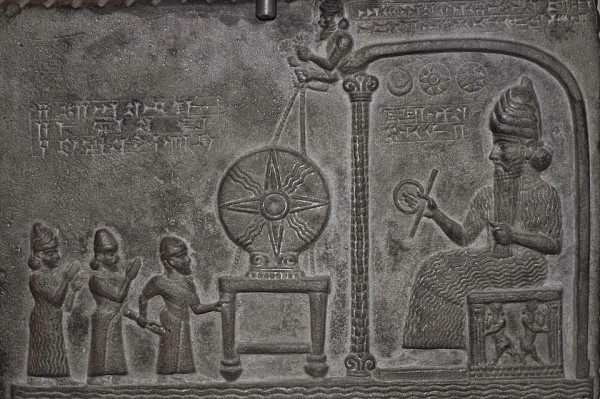
A carved stone tablet depicting a scene of the worship of the sun god Shamash at the ancient Mesopotamian temple of Sippar. The scene is sometimes associated by researchers and history enthusiasts with the Anunnaki, the principal deities of Sumerian, Akkadian, and Babylonian mythology, in the context of divine gatherings or ritual offerings. The original tablet dates to approximately 860–850 BC. Image credits: Public domain (as claimed by the source). The image is available on Wikimedia Commons
Ishtar TV
For thousands of years, the peoples of Mesopotamia left behind cuneiform texts exploring the origins of humanity and its relationship with the gods. Some of these ancient accounts describe humans as being created from clay combined with elements from a divine body. Today, advances in DNA analysis and the study of ancient human genomes have renewed interest in these texts, raising questions about whether the Anunnaki myths might be connected to modern scientific investigations into human origins.
However, any attempt to link ancient mythology with genetics must distinguish between what historical texts actually describe and what scientific evidence demonstrates. Similarities between ancient narratives and modern concepts do not, by themselves, establish a biological connection or prove that non-human beings influenced human evolution.
1. Who Were the Anunnaki in Ancient Mesopotamia?
The Anunnaki were a group of deities in ancient Sumerian, Akkadian, and Babylonian religious traditions. Their roles and status varied across texts and historical periods, and some accounts associated them with divine authority and the determination of human destinies.
Mesopotamian mythology contains several accounts of the creation of the world and humanity. In the Babylonian Atrahasis Epic, for example, the gods decide to create humans to take over work that had burdened the lesser gods. In this account, humanity is formed from clay mixed with the flesh and blood of a deity who is killed for that purpose.
Cuneiform studies published through the University of Pennsylvania's Ancient Mesopotamian Gods and Goddesses project help place such creation narratives within the religious and symbolic traditions of the ancient Near East.
Sources: University of Pennsylvania – Ancient Mesopotamian Gods and Goddesses; The Metropolitan Museum of Art.
2. Does the Ancient Creation Story Resemble What We Know About DNA?
In Mesopotamian mythology, clay serves as the material from which the human body is formed, while divine blood or other divine elements may symbolize life, intelligence, or a connection with the sacred realm. These concepts, however, are not equivalent to the modern biological understanding of DNA.
Deoxyribonucleic acid (DNA) is a molecule that carries genetic information in living cells. It contains instructions that contribute to an organism's development and functioning and helps transmit inherited characteristics across generations. Modern understanding of DNA's molecular structure emerged in the twentieth century, thousands of years after the Mesopotamian creation myths were composed.
Known cuneiform texts do not describe DNA, chromosomes, or genes in the modern scientific sense. Interpreting the phrase “divine blood” as a literal reference to DNA is therefore a contemporary interpretation, not a conclusion established by archaeologists or geneticists.
The comparison is cultural and intellectual, not scientific evidence that ancient Mesopotamian scribes understood modern genetics.
3. What Has Ancient DNA Revealed About the People of Mesopotamia?
Unlike mythological narratives, ancient DNA research provides testable evidence about people who lived in the region and the movements and mixing of populations over thousands of years.
A study published in Genome Biology in 2026 analyzed DNA from 17 individuals at the archaeological site of Bakr Awa in northeastern Iraq. The individuals lived during the Bronze and Iron Ages.
The findings indicated substantial genetic diversity among Bronze Age individuals, including ancestry related to populations from Anatolia, the Levant, and the Caucasus, alongside local ancestry. The study also identified changes in genetic composition over time, consistent with the region's long history of migration, trade, and interaction between populations.
These findings do not indicate the existence of Anunnaki genes or supernatural intervention in human origins. Rather, they document changes in the ancestry of human populations.
Source: Genome Biology – Ancient DNA research at Bakr Awa, published June 12, 2026.
Another study published in Science in 2022 examined ancient DNA from Neolithic populations in Mesopotamia and neighboring regions. It identified genetic connections among ancient communities in western Asia and evidence of migration and population mixing that contributed to the formation of early farming societies.
Source: Science – Ancient DNA and Neolithic migrations in western Asia.
4. Could Human Genes Contain Evidence of the Anunnaki?
Scientifically, DNA can reveal relationships between individuals and populations, evidence of interbreeding, and traces of ancient migrations. It can also help researchers investigate evolutionary relationships between modern humans and ancient human relatives, including Neanderthals.
However, establishing the hypothesis that the Anunnaki genetically intervened in human origins would require independent, verifiable evidence. This would include authenticated biological samples, genetic sequences suitable for analysis, results reproducible by independent research teams, and an interpretation consistent with established principles of genetics and evolution.
To date, there is no reliable genetic evidence demonstrating that the Anunnaki were extraterrestrial beings, altered human DNA, or created modern humans. Such claims appear in some contemporary books and online publications, but they are not established conclusions supported by published genetic research.
Likewise, similarities between an ancient myth and a modern scientific concept do not prove that the people who composed the myth possessed knowledge of that concept. Each claim must be evaluated against available evidence rather than resemblance alone.
5. Why Do Theories Connecting the Anunnaki and Human Genetics Continue to Spread?
These theories attract attention because they bring together three enduring subjects of human curiosity: the mysteries of ancient civilizations, the origins of humanity, and rapid advances in genetics.
Their appeal can increase when cuneiform texts are interpreted literally or when references to “gods” are reimagined as descriptions of technologically advanced beings. Such interpretations, however, are not the established historical approach in specialized studies of ancient languages and religions.
The absence of evidence for extraterrestrial intervention does not diminish the historical value of Mesopotamian mythology. These texts remain important sources for understanding how ancient people interpreted the world, life and death, labor, authority, and the relationship between humans and the divine.
Conclusion: Mythology Raises Questions; Science Tests the Answers
The Anunnaki traditions and Mesopotamian creation myths offer a window into the intellectual and religious world of ancient Mesopotamia. Modern DNA research, meanwhile, makes it possible to investigate the biological history of the region's populations in ways that were unimaginable in antiquity.
Research has demonstrated that Mesopotamia was home to ancient human communities whose ancestry was shaped over thousands of years by migration, interaction, and population mixing. It has not established a genetic relationship between humans and the Anunnaki as non-human beings.
Bringing history and genetics together can produce valuable insights when each type of evidence is treated according to its nature: cuneiform texts reveal ancient beliefs and worldviews, while DNA provides biological evidence about human ancestry and population movements. There is considerable room for further historical and scientific investigation, but mythology cannot be transformed into a genetic fact without evidence.
Sources and References
-
University of Pennsylvania – Ancient Mesopotamian Gods and Goddesses (ORACC). An academic resource on Mesopotamian deities and religious traditions.
https://oracc.museum.upenn.edu/amgg/listofdeities/mothergoddess/
-
The Metropolitan Museum of Art. Educational and historical resources on ancient Mesopotamian art, religion, and mythology.
https://www.metmuseum.org/
-
Williams, M. P. et al. (2026). “Mesopotamian ancient DNA reveals Iron Age integration of heterogeneous Bronze Age genetic ancestries following resettlement.” Genome Biology, volume 27, article 260. Research analyzing ancient DNA from 17 individuals at Bakr Awa in northeastern Iraq.
https://doi.org/10.1186/s13059-026-04145-4
-
Lazaridis, I. et al. (2022). “Ancient DNA from Mesopotamia suggests distinct Pre-Pottery and Pottery Neolithic migrations into Anatolia.” Science, volume 377, pages 982–987. Research examining ancient ancestry and Neolithic population movements in Mesopotamia and western Asia.
https://doi.org/10.1126/science.abq0762
-
Oxford Classical Dictionary (2024). “Ghosts, Mesopotamia.” An academic reference on aspects of Mesopotamian beliefs, including traditions concerning the Atrahasis Epic and the creation of humans from clay mixed with divine flesh and blood.
https://doi.org/10.1093/acrefore/9780199381135.013.9024
Editorial note: These references address ancient religious texts and the genetic history of human populations. They do not provide evidence of a genetic connection between the Anunnaki and humans or of extraterrestrial intervention in human origins.
|