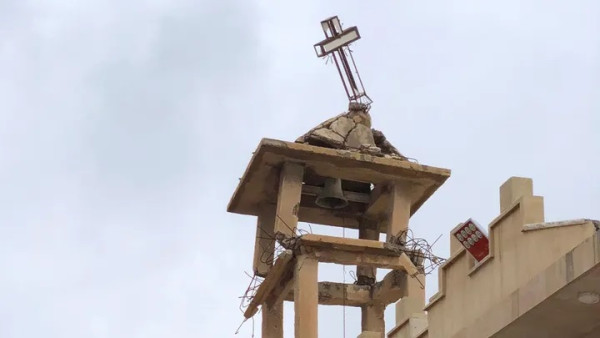
The bell tower of St. Adday Church in Karamles, a town that the "Knights of Columbus" organization helped rebuild. The crooked cross is still standing despite the defeat of ISIS in the region. The artistic and photographic intellectual property rights belong to the (Knights of Columbus) through the lens of photographer "Tamino Petelinsek", and the documentary material was officially published via the Fox News network; it is licensed for media, journalistic, and academic use within coverage related to the reconstruction of the Nineveh Plains towns and monitoring the impacts of exclusionary thought against the indigenous components in the region. Direct digital source: (foxnews.com).
From massacres and forced
displacement in the final years of the Ottoman Empire to the crimes committed
by ISIS in Iraq and Syria, history reveals dangerous periods in which religious
fanaticism, political conflicts, and nationalist ambitions turned into
systematic persecution targeting our Chaldean, Syriac, Assyrian people and
other Christians in the Middle East.
Ishtartv.com
Extremist ideology targeting our
Chaldean, Syriac, Assyrian people and Middle Eastern Christians did not emerge
at a single point in history, nor was it the result of one isolated factor. It
evolved within different historical contexts in which religious disputes
intersected with political and national conflicts and economic interests,
eventually contributing to the emergence of modern terrorist organizations that
adopted exclusionary ideologies and justified violence against civilians on the
basis of their religious identity.
Throughout the centuries, the
region experienced periods of coexistence and cultural and economic cooperation
among its communities, as well as periods of discrimination, persecution,
massacres, and forced displacement. Studying these developments reveals that
the danger intensifies when religious differences become grounds for collective
accusations, or when the presence of a historic community is portrayed as a
threat that must be eliminated.
These practices reached
particularly devastating levels during the massacres suffered by our Chaldean,
Syriac, Assyrian people in the final years of the Ottoman Empire, and later
during the Islamic State's advance across large areas of Iraq and Syria, accompanied
by killings, displacement, property confiscation, and the destruction of
churches, monasteries, and historical sites.
How did extremist ideology
targeting our people evolve? Which historical developments contributed to its
formation? And what distinguishes persecution in earlier eras from organized
terrorism in the modern age?
1. Historical Roots: When
Religious Differences Became Political Conflicts
During the first centuries of
Christianity, Christians in various parts of the Roman Empire experienced
periods of persecution. Following Emperor Constantine's embrace of Christianity
and the Edict of Milan in 313, and later the elevation of Christianity to a
favored religion of the state under Theodosius I in the late fourth century,
Christianity's position within the imperial system changed significantly.
However, this transformation did
not eliminate religious conflict. Doctrinal disputes emerged within Christian
communities themselves, and some became closely connected to political
authority and the relationship between churches and the state.
Following the Council of
Chalcedon in 451, Christians who rejected its decisions, including communities
associated with the Syriac Miaphysite tradition, experienced periods of
restrictions, exile, and violence under certain imperial authorities.
Historian Christine Shepardson,
in her book A Memory of Violence: Syriac Christianity and the Radicalization of
Religious Difference in Late Antiquity, examines how doctrinal disputes in the
fifth and sixth centuries became part of political struggles over acceptable
religious belief and the relationship between the church and the state.
This period illustrates an
important mechanism in the history of persecution: when religious doctrine
becomes tied to political loyalty, religious differences can be transformed
into accusations of disloyalty or heresy and used to justify exclusion and punishment.
Nevertheless, these conflicts
should not be regarded as the direct beginning of contemporary jihadist
terrorism. Their historical significance lies in demonstrating how the
politicization of religious identity can become a tool of persecution.
2. After the Islamic
Conquests: Between Legal Discrimination and Periods of Coexistence
Following the Islamic conquests
in the seventh century, extensive areas of the Levant, Iraq, and Egypt came
under successive Muslim-ruled states. These territories were home to ancient
Christian communities with established ecclesiastical institutions, languages,
and cultural traditions, including our Chaldean, Syriac, Assyrian people.
Over subsequent centuries, the
circumstances of Christians were not uniform across different states and
historical periods. Churches and their institutions continued to operate, and
Christians participated in medicine, administration, translation, philosophy,
and trade. At other times, however, restrictions, special taxes, persecution,
and acts of violence occurred.
One of the legal frameworks
governing certain non-Muslim communities was the system known as dhimma. It
provided protection and permitted religious practice under conditions that
varied historically, while also establishing a legal distinction between Muslims
and non-Muslims, including arrangements involving the jizya tax in particular
historical contexts.
In some periods, authorities or
local groups used these distinctions to impose stricter restrictions or exert
pressure on Christians. In other periods, opportunities for social, economic,
and cultural participation expanded.
Historian Christian Sahner, in
Christian Martyrs under Islam: Religious Violence and the Making of the Muslim
World, examines the history of religious violence against Christians during the
early and medieval Islamic periods and how Christian communities responded to
social, legal, and religious pressures.
Historical perspective: The
history of Christians in the Middle East cannot be reduced to uninterrupted
persecution, nor can the discrimination and violence they experienced be
denied. A scholarly interpretation requires distinguishing general legal frameworks
from their actual implementation, and the policies of different authorities
from violence committed by local groups or crowds.
3. How Does Religious
Difference Turn into Exclusionary Ideology?
Religious discrimination alone
was not sufficient to produce organized terrorism. Contemporary terrorist
movements emerged in modern contexts shaped by state crises, armed conflicts,
and ideological mobilization.
Nevertheless, several recurring
mechanisms can be identified across different periods of persecution.
Monopolizing religious truth:
When a group claims exclusive possession of religious truth, it may move from
disagreeing with others to treating them as a threat that must be controlled or
eliminated.
Denying legitimacy to others:
Targeted communities may be portrayed as outsiders or as people undeserving of
equal rights, making discrimination against them easier to justify.
Linking religious identity to
political hostility: Local Christians may be accused of representing a foreign
power or supporting a political adversary, even when no evidence supports such
allegations.
Turning individual responsibility
into collective punishment: Rather than holding individuals accountable for
specific actions, an entire religious community is blamed for the actions of
individuals or political forces. This can expose the community to threats,
confiscation of property, or displacement.
Justifying violence in the name
of a sacred cause: Some extremist movements selectively interpret religious
teachings to give violence a false legitimacy and portray victims as legitimate
targets.
These mechanisms are not
exclusive to any one religion, nor do they necessarily appear in every
religious community or movement. They help explain how exclusionary ideas can
become organized persecution when backed by armed force, political protection,
or the collapse of state institutions.
4. The Final Years of the
Ottoman Empire: Sayfo and the Tragedy of Our Chaldean, Syriac, Assyrian People
The final decades of the Ottoman
Empire witnessed escalating national and political tensions alongside imperial
decline, foreign intervention, wars, and internal crises.
Our Chaldean, Syriac, Assyrian
people, together with Armenians, Greeks, and other Christian communities, were
among those subjected to massacres, forced displacement, and property
confiscation, particularly during the First World War and its aftermath.
Sayfo: A Historical Wound in
Our People's Memory
In 1915 and the years surrounding
it, mass killings and forced displacement affected our Chaldean, Syriac,
Assyrian people in parts of Anatolia, Mesopotamia, and border areas of
present-day Iran.
Known in Assyrian and Syriac
historical memory as Sayfo, meaning “sword” in Aramaic, this tragedy is
associated with the killing of large numbers of our people, the destruction of
villages, churches, and monasteries, and the displacement of extensive communities
from their historic homeland.
Historian David Gaunt and his
co-authors examine the political, military, and social factors surrounding
these massacres in Let Them Not Return: Sayfo – The Genocide Against the
Assyrian, Syriac, and Chaldean Christians in the Ottoman Empire, drawing on historical
sources, testimonies, and documentary evidence.
David Gaunt also discusses the
complexities of the genocide against the Assyrians in a study published in
Genocide Studies International, examining the context of the violence, the
parties involved, and the targeting of different Christian communities.
What Does Sayfo Reveal About
the Development of Exclusionary Ideology?
Sayfo cannot be explained by
religious fanaticism alone. The massacres took place amid wartime policies,
suspicions about the loyalty of Christian communities, exclusionary
nationalism, disputes over land and political authority, local interests, and
violence committed by institutions and armed actors.
Nevertheless, the tragedy reveals
a grave danger that emerges when a religious or national community becomes a
collective target and its very existence is treated as a political or security
problem to be eliminated.
This highlights the importance of
distinguishing political disputes from persecution based on identity. When
propaganda and incitement combine with confiscation, forced displacement, and
killing, a conflict can become a campaign threatening the existence of entire
communities.
5. The Twentieth Century: From
Nation-States to Armed Movements
Following the First World War,
political boundaries in the Middle East changed, and new states emerged. These
states faced challenges in building national identities and managing religious
and ethnic diversity.
Although our Chaldean, Syriac,
Assyrian people and other Christians participated in the political, cultural,
and economic life of regional countries, they experienced discrimination,
violence, and pressures to emigrate in some places. These developments resulted
from varying circumstances, including political conflicts, coups, wars,
sectarian tensions, and weak state institutions.
In Iraq, our people faced attacks
and threats both before and after 2003. As security deteriorated following the
invasion, armed groups expanded their activities, and towns and districts with
Christian populations became targets of extortion, assassinations, and
bombings.
In Syria, the war that began in
2011 led to the breakdown of security and administrative institutions across
extensive areas, creating conditions that allowed extremist armed groups to
expand their influence.
In Egypt, Coptic Christians
experienced attacks against churches and civilians in different contexts. Some
were connected to local sectarian tensions, while others involved organized
jihadist groups.
These experiences demonstrate
that the rise of extremism was not driven by ideas alone. It was also linked to
political and security environments that enabled recruitment, the arming of
groups, the weakening of the judiciary, and attacks on civilians without
effective accountability.
6. Al-Qaeda and ISIS: The
Transformation of Exclusionary Ideology into Organized Terrorism
The final decades of the
twentieth century and the beginning of the twenty-first witnessed the
development of radical jihadist movements that adopted exclusionary
interpretations of religion and regarded certain religious and political groups
as enemies to be subjugated or fought.
With the establishment of
al-Qaeda and the development of its regional branches, followed by the
emergence of al-Qaeda in Iraq, more organized forms of sectarian violence
appeared. In 2013, the organization operating in Iraq and Syria announced its
reorganization under the name the Islamic State of Iraq and Syria, commonly
known as ISIS.
The United States Commission on
International Religious Freedom, in its report on religious freedom in Iraq ten
years after ISIS's crimes, documents how the organization targeted Yazidis, our
Chaldean, Syriac, Assyrian people, and other communities from 2014 onward. Its
crimes included mass executions, abductions, rape, sexual enslavement, and
forced conversion to Islam.
How Did ISIS Construct Its
Ideological Narrative Against Christians?
The organization relied on
several exclusionary ideas and practices, including:
- Presenting its political project as an absolute
religious authority that rejected pluralism and equal citizenship.
- Imposing hardline views on the status of non-Muslims
and using threats and extortion to force residents to submit or leave.
- Destroying religious and cultural symbols it
considered incompatible with its ideology.
- Using photographs, videos, and digital propaganda to
demonstrate power and terrorize civilians and opponents.
- Employing mass violence and displacement to alter the
demographic reality of areas under its control.
The organization's rhetoric and
practices were not identical in every region or circumstance. Its treatment of
Christians varied according to local military and political conditions.
Nevertheless, ISIS committed documented abuses against Christians in Iraq and
Syria, including property seizures, displacement, destruction, and the
deliberate spread of fear.
An academic study entitled
Crusader Hirelings or Loyal Subjects? Evolving Jihadist Perspectives on
Christian Minorities in the Middle East argues that jihadist movements'
positions toward Christians evolved according to political circumstances and
conflicts among organizations. Their targeting of Christians was not always the
product of a single, unchanging ideological position; it was also influenced by
territorial ambitions and local struggles.
7. Mosul and the Nineveh
Plains: When Exclusionary Ideology Became a Crime
In June 2014, ISIS seized Mosul
and subsequently advanced into parts of the Nineveh Plains. Within weeks, our
Chaldean, Syriac, Assyrian people faced threats that forced them to flee their
cities and villages, creating one of the largest waves of Christian
displacement in modern Iraqi history.
Residents experienced the
confiscation of homes, shops, and other property. Churches, monasteries, and
religious sites were looted, damaged, or desecrated.
In September 2024, the United
Nations Investigative Team to Promote Accountability for Crimes Committed by
Da'esh (UNITAD) announced that it had submitted a report to Iraq's Supreme
Judicial Council concerning crimes committed against Christians in Mosul, the
Nineveh Plains, and surrounding areas between 2014 and 2017.
The team found reasonable grounds
to believe that acts committed by ISIS against Christians amounted to war
crimes and crimes against humanity. These included sexual violence, violations
of human dignity, destruction of cultural property, looting, the spread of
terror among civilians, and forcible transfer.
These findings are particularly
important because they are based on investigations, evidence, and survivor
testimonies rather than merely on media or political descriptions.
Was the Objective to Erase the
Christian Presence from the Region?
ISIS's actions emptied certain
areas of their Christian populations, destroyed parts of their heritage, and
undermined the ability of displaced people to return and rebuild their lives.
However, establishing genocidal
intent under international law requires evidence of a specific intention to
destroy a protected group, in whole or in part, as such. It is therefore
important to distinguish established war crimes and crimes against humanity
from the legal classification of a particular campaign or incident as genocide.
International bodies have
documented ISIS's crimes against Christians, while the United Nations has
applied the genocide designation in its investigations into the organization's
crimes against the Yazidis. These legal classifications should not be conflated,
nor should one group's suffering be minimized because of the different legal
classification applied to another.
8. Attacks on Christians in
Syria, Egypt, and Other Countries
Jihadist attacks were not
confined to Iraq. Christians in Syria, Egypt, and other countries experienced
assaults linked to different local circumstances and organizations.
Syria
During the Syrian war, extremist
armed groups controlled areas inhabited by our Chaldean, Syriac, Assyrian
people and other Christian communities. Residents faced threats, displacement,
and abduction, while clergy were kidnapped and religious sites were destroyed.
Conditions differed from one area
to another. Some attacks were associated with the control of jihadist groups,
while others resulted from the collapse of security, fighting among armed
factions, or local social and political pressures.
Egypt
Coptic Christians experienced
attacks against churches and civilians, including the bombing of the Saints
Church in Alexandria on January 1, 2011, and the attacks on St. George's Church
in Tanta and the Saint Mark's Cathedral in Alexandria in April 2017.
ISIS also claimed responsibility
for attacks targeting Copts as part of an effort to provoke sectarian conflict
and portray the state as incapable of protecting its citizens.
Lebanon, Jordan, and Other
Countries
The threats facing Christians
elsewhere in the region vary. Some countries have experienced direct terrorist
attacks, while challenges in others include political tensions, emigration,
inadequate legal protection, or the consequences of wars in neighboring
countries.
It is therefore inaccurate to
treat all these cases as part of one identical process or attribute them all to
a single organization. Each incident requires examination of the responsible
party, motive, evidence, and local context.
9. What Factors Allow
Terrorist Ideology to Expand?
An extremist narrative alone
cannot explain the transformation of radical ideas into widespread violence.
Contemporary experiences point to several factors that can facilitate the
expansion of terrorist groups.
The collapse of state
institutions: Weak policing, ineffective courts, and inadequate control of
weapons allow armed groups to impose their authority.
Sectarian conflict: When
political disagreements are presented as existential struggles between
religious communities, civilians become more vulnerable to collective
targeting.
Propaganda and incitement:
Rumors, hate speech, and conspiracy theories can contribute to portraying
entire communities as enemies.
Impunity: A lack of
accountability encourages the repetition of crimes, particularly when attacks
against places of worship and private property are not independently
investigated.
Economic interests: Extremist
groups may use extortion, property confiscation, and illicit trafficking in
antiquities to finance their activities and consolidate control.
Exploitation of social and
political grievances: Organizations may exploit anger and marginalization to
recruit individuals and then direct them toward violence against other
communities.
The presence of these factors
does not mean that every society experiencing them will inevitably face
terrorism, nor does poverty or marginalization automatically lead to extremism.
Rather, these conditions interact with leadership decisions, recruitment
networks, ideologies, and access to armed force.
10. Extremist Ideology in the
Digital Age
Modern technology has added new
dimensions to terrorist propaganda. In the past, incitement spread through
publications, sermons, and limited organizational networks. Today, terrorist
organizations can exploit digital platforms to spread hate speech, recruit
supporters, broadcast scenes of violence, and mislead the public.
It has also become easier to
recycle old images of attacks or circulate unverified reports to inflame
tensions between religious communities.
These developments mean that
combating terrorism is no longer solely a security issue. It also requires
protecting the media environment from incitement, strengthening information
verification, documenting abuses, and supporting public discourse that protects
everyone's right to live with difference.
At the same time, a distinction
must be made between conservative religious expression or legitimate political
criticism and direct incitement to violence or calls to deprive a community of
its fundamental rights. Equal citizenship, freedom of expression, and
protection of places of worship are essential to countering extremism without
undermining fundamental rights.
11. Protecting the Historic
Presence of Our Chaldean, Syriac, Assyrian People
The experience of our people
demonstrates that addressing the consequences of terrorism does not end when
armed organizations lose territorial control.
The return of displaced people
requires security, housing, employment opportunities, and the restoration of
property. It also requires protecting churches, monasteries, manuscripts,
language, and cultural heritage. Affected communities need efforts to establish
the fate of missing persons, support survivors, and hold those responsible for
crimes accountable through fair judicial procedures.
In Iraq, protecting the historic
presence of our Chaldean, Syriac, Assyrian people remains closely linked to
equal citizenship, the implementation of constitutional rights, the prevention
of discrimination, and the protection of the Nineveh Plains and Mosul from
renewed armed-group activity or pressures that force residents to emigrate.
At the regional level,
governments, religious institutions, civil society organizations, and
international bodies must cooperate to prevent hate incitement, strengthen
historical and religious education that rejects the dehumanization of others,
and pursue networks that finance terrorism or traffic in antiquities and stolen
property.
Conclusion: From the
Politicization of Difference to the Targeting of an Entire Community
Extremist ideology targeting our
Chaldean, Syriac, Assyrian people and Middle Eastern Christians did not evolve
along a straight line or arise from a single cause. Throughout history,
religious disputes intersected with political and national conflicts. In the
modern era, armed organizations emerged that adopted exclusionary ideologies
and used accusations of apostasy, propaganda, and organized violence to impose
their projects.
The massacres suffered by our
people in the final years of the Ottoman Empire, followed by the crimes
committed by ISIS against them in Iraq and Syria, demonstrate how collective
suspicion, discrimination, and incitement can escalate into displacement and
the destruction of communities.
Nevertheless, understanding
history requires avoiding the equation of all eras, governments, and movements,
and rejecting the attribution of the actions of extremist groups or particular
authorities to an entire religion or people.
Combating terrorism begins with
rejecting the transformation of religious identity into an accusation. It
requires building institutions that protect rights, prevent impunity, and
guarantee our Chaldean, Syriac, Assyrian people and all communities of the
Middle East the right to live, worship, enjoy citizenship, and remain in their
ancestral homeland.
The problem is not the existence
of religious difference, but an ideology that turns that difference into a
justification for denying human beings their right to existence, security, and
dignity.
Sources and References
1. United Nations – Investigative
Team to Promote Accountability for Crimes Committed by Da'esh (UNITAD):
Findings on international crimes committed by ISIS against Christians in Iraq,
particularly in Mosul and the Nineveh Plains between 2014 and 2017.
Read
the United Nations report
2. United States Commission on
International Religious Freedom (USCIRF): Religious Freedom Challenges in Iraq:
10 Years After ISIS's Genocide. The report addresses crimes against religious
communities, including our Chaldean, Syriac, Assyrian people.
Read
the full report – PDF
3. Peer-reviewed academic study:
Crusader Hirelings or Loyal Subjects? Evolving Jihadist Perspectives on
Christian Minorities in the Middle East. Examines the evolution of jihadist
movements' positions toward Christians in the Middle East.
Read
the study – Taylor & Francis Online
4. David Gaunt and colleagues:
Let Them Not Return: Sayfo – The Genocide Against the Assyrian, Syriac, and
Chaldean Christians in the Ottoman Empire. A historical reference on the Sayfo
massacres targeting our people during the final years of the Ottoman Empire.
Access
the book through JSTOR
5. Academic study: The Complexity
of the Assyrian Genocide. Examines the complex historical and political
circumstances surrounding the genocide against the Assyrians in the final years
of the Ottoman Empire.
Read the
study
6. Christine Shepardson: A Memory
of Violence: Syriac Christianity and the Radicalization of Religious Difference
in Late Antiquity. Examines religious difference, political authority, and
violence in late antiquity.
Access
the book through JSTOR
7. Christian Sahner: Christian
Martyrs under Islam: Religious Violence and the Making of the Muslim World.
Studies religious violence against Christians during the early and medieval
Islamic periods.
Access
the book through Oxford Academic
Editorial note: These references
support the historical and analytical themes discussed in the report. They do
not imply that every period of persecution had a single cause. Religious,
political, national, and military factors interacted differently across
historical periods.
|