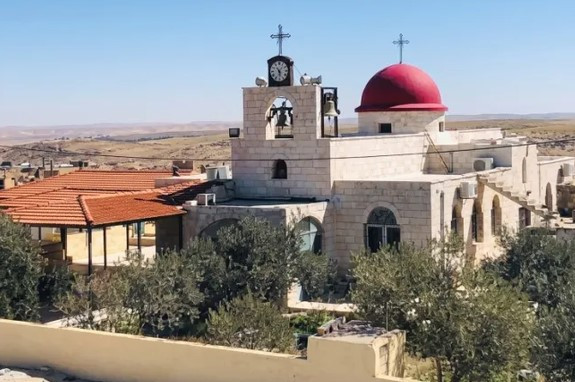
St. George’s Orthodox Church in Karak, Jordan. The church is distinguished by its red dome and historic stone bell tower, topped by a clock and cross, and surrounded by olive trees in a rural setting that reflects the longstanding historical roots of Eastern Christians in the region. Photo credit: Council of Church Leaders in Jordan and official media platforms affiliated with the Orthodox Archdiocese.
Ishtartv.com
Sunday, October 25, 2026
The death toll from the armed
attack on St. George’s Greek Orthodox Church in the village of Hamoud, in
Jordan’s southern Karak Governorate, has risen to nine, with approximately 40
people injured, according to the latest published reports. The attack took
place during a funeral service. As Jordanian security forces continue their
investigation and efforts to track down those responsible, King Abdullah II has
called for decisive action, a comprehensive review of security measures, and
efforts to address the roots of extremist ideology. The attack has prompted
condemnations from church leaders and official institutions, alongside calls to
protect national unity and prevent the crime from being exploited to fuel
division.
Gunmen Open Fire During
Funeral Service
The attack took place on Friday,
October 23, 2026, at St. George’s Greek Orthodox Church in Hamoud village, in
Karak Governorate. Local residents had gathered for a funeral when gunmen
opened fire, killing and injuring several people.
According to media reports citing
authorities and eyewitnesses, surveillance footage showed armed men approaching
the church entrance and opening fire. The precise circumstances of the
attack—including the identities of all those involved, their motives, and
whether any organization was behind them—remain under investigation by
Jordanian authorities.
In its initial briefing, Jordan’s
Public Security Directorate reported that seven people had been killed and 34
injured. On Saturday, October 24, the official Jordan News Agency, Petra,
reported that the death toll had risen to eight after another injured person
died from their wounds. Subsequent reports put the death toll at nine.
Latest Medical and
On-the-Ground Developments
Jordanian newspaper Ammon News
reported on Sunday morning, October 25, that preparations had begun to transfer
the victims’ bodies from Karak Government Hospital to the nearby Hamoud
cemetery. It also reported that the injured receiving treatment at Karak
Hospital were in stable condition.
The report added that three
injured people had been discharged from hospital on Saturday after their
conditions stabilized, while further discharges were expected depending on
patients’ medical progress. Some victims had sustained direct and serious injuries,
making medical intervention more difficult in cases involving internal
bleeding.
King Abdullah II Calls for
Accountability and a Security Review
Following the attack, King
Abdullah II stressed the need to pursue everyone responsible for the crime and
bring them to justice, emphasizing that the security of Jordanians and national
unity are red lines.
According to Jordanian media
reports, the King directed the relevant authorities to:
- Pursue those involved in the attack, as well as
anyone proven to have supported or justified the crime, in accordance with
the law.
- Conduct a comprehensive security assessment of the
response to the attack and strengthen measures to improve preparedness and
prevent similar incidents.
- Review policies aimed at countering extremist
ideology and address its underlying causes in coordination with relevant
religious authorities.
- Counter rumors and misleading information that could
be used to spread fear and division among Jordanians.
Prime Minister Jaafar Hassan also
stated that state institutions were working to track down those responsible and
confront extremism at its roots.
Have the Attackers’ Identities
Been Announced?
As of the latest reports
available on October 25, Jordanian authorities had not announced definitive
findings identifying all the perpetrators or establishing a confirmed link to
any particular organization.
A report published by Al Jazeera
on October 24 said the investigation was continuing and that the attackers’
identities had not yet been publicly established at the time of publication.
Reports also indicated that security forces were continuing their efforts to
locate those responsible.
It is therefore important to
distinguish between the Jordanian authorities’ characterization of the attack
as a terrorist act and the establishment of criminal or organizational
responsibility. The latter requires evidence and official investigative findings.
Greek Orthodox Patriarchate
Condemns the Attack
The Greek Orthodox Patriarchate
of Jerusalem, headed by Patriarch Theophilos III and Archbishop Christophoros,
condemned the attack on St. George’s Church in Hamoud.
The Patriarchate offered
condolences to the victims’ families, the Jordanian people, and the Hashemite
leadership. It also expressed confidence in the ability of Jordan’s security
services to pursue those responsible and bring them to justice.
The Patriarchate stressed that
the attack would not succeed in undermining national unity or uprooting
Christians from their homeland. It reaffirmed that Christians are an integral
part of Jordan’s history, present, and future.
Church Bells Ring in
Solidarity with the Victims
On Saturday, October 24, church
bells rang across Jordan at noon in remembrance of the victims, expressing
mourning and solidarity with their families.
Condemnations and messages of
condolence also came from church leaders and religious institutions across the
region. These statements rejected attacks on places of worship and called for
the protection of civilians and for preventing the crime from being used to
provoke religious divisions.
The Catholic news service OSV
News reported on the ringing of church bells in memory of the victims of
the attack, which left nine people dead and dozens injured. Church statements
in Jordan also emphasized that the historic relationship between Muslims and
Christians forms an integral part of the country’s national fabric.
What Does the Attack Mean for
the Christian Presence in the Region?
The significance of the attack
extends beyond its death toll because it targeted a place of worship during a
religious and social gathering that should have been safe. It has also renewed
concerns about attacks on Christian communities and places of worship in a
region that has witnessed extremist violence in Iraq, Syria, and Egypt in
recent years.
However, determining the specific
motives behind this attack—or concluding that it was part of an organized
campaign against Christians—requires the results of the Jordanian
investigation. The identity or organizational affiliation of the attackers
cannot be inferred solely from the nature of the target.
At this stage, priorities include
protecting places of worship, ensuring accountability, supporting the families
of those killed and injured, and rejecting hate speech and rumors that could be
used to incite hostility against any religious community.
Conclusion
As of Sunday, October 25, 2026,
the latest available reports indicate that the death toll from the attack on
St. George’s Church in Karak has risen to nine, with approximately 40 people
injured. Several injured people were reported to be in stable condition, and
preparations had begun to transfer the victims’ bodies to Hamoud cemetery.
Jordanian authorities are
continuing their efforts to pursue those responsible. King Abdullah II has
called for stronger security measures and action against extremist ideology,
while church leaders have condemned the attack and reaffirmed their commitment
to peaceful coexistence.
The key development now awaited
is the official announcement of the investigation’s findings, including the
identities and motives of the attackers and any possible organizational links,
without prejudging what the evidence may establish.
|