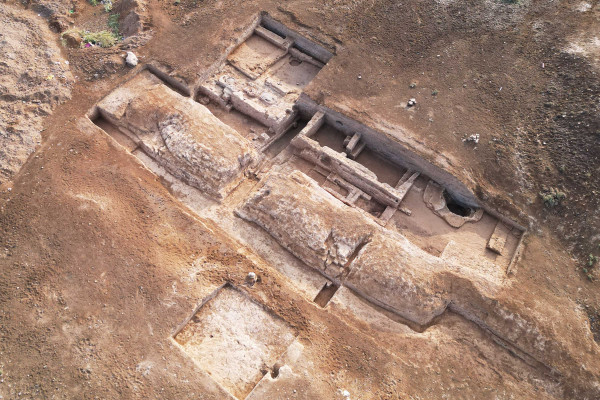
rchaeological remains at Tell Muhammad in southeastern Baghdad, where Iraqi and Italian archaeologists are conducting excavations that have revealed structures dating back to the Old Babylonian period. Photo credit: University of Catania – UnictMagazine
Iraqi-Italian excavations
uncover evidence of ancient bread and beer production, defensive walls and
burial practices dating back around 4,000 years, while plans advance to develop
the historic site into an archaeological park.
Baghdad – Ishtar TV
New archaeological discoveries at
Tell Muhammad, located in southeastern Baghdad, are providing fresh insights
into everyday life in ancient Mesopotamia, particularly during the Old
Babylonian period associated with King Hammurabi.
The latest findings were
announced following archaeological excavations conducted by an Italian mission
from the University of Catania in cooperation with Iraq’s State Board of
Antiquities and Heritage. The joint project, launched in 2022, aims to investigate
the ancient settlement, preserve its archaeological remains and develop the
site into an archaeological park.
Among the most notable
discoveries are possible facilities used for bread production and beer brewing,
alongside defensive structures, ancient gates and evidence of metalworking and
burial practices.
Evidence of Ancient Bread and
Beer Production
In a report published on November
2, 2026, Euronews highlighted new discoveries at Tell Muhammad that shed light
on food production and daily activities in Mesopotamia approximately 4,000
years ago.
According to Nicola Laneri,
professor of archaeology at the University of Catania and leader of the
archaeological mission, excavations revealed an area believed to have been used
for bread production and possibly beer brewing.
One particularly significant
discovery was a cuneiform tablet referring to a person receiving barley and
producing a type of Mesopotamian beer known as "Kurun".
Laneri explained that researchers
are still translating the tablet, which could provide further information about
ancient food production and economic activities.
Defensive Walls and Ancient
City Gates
Excavations have also uncovered
remains of the settlement's defensive walls and two gates, one of which is
believed to have served as a smaller passage possibly used by military forces.
These architectural remains
provide important evidence about the city's urban planning, defensive
arrangements and organisation during the Old Babylonian period.
According to a report published
by The National on October 29, 2026, archaeologists also identified evidence of
metalworking, food-production facilities and ancient funerary practices.
The discoveries are helping
researchers reconstruct the relationship between residential areas, production
activities and the defensive infrastructure of the ancient settlement.
Evidence of Metalworking and
Ancient Burial Practices
Beyond architectural remains and
food-production facilities, archaeological investigations have revealed traces
of metalworking and activities associated with the processing of metals.
Researchers have also identified
evidence of ancient burial practices, including burials beneath the floors of
buildings.
Together, these discoveries offer
a broader understanding of the economic, social and cultural life of the
settlement and the activities that took place within its residential and
production areas.
Plans to Develop Tell Muhammad
into an Archaeological Park
Alongside the excavation work,
Iraqi authorities are advancing plans to transform Tell Muhammad into an
archaeological park that will preserve the site and make its historical
significance more accessible to visitors.
On October 26, 2026, a protective
roofing system was presented at the site as part of efforts to safeguard the
excavated remains.
The event was attended by Ali
Obaid Shalgham, head of Iraq's State Board of Antiquities and Heritage, and
Italian Ambassador to Iraq Niccolò Fontana.
The project includes the
protection and restoration of archaeological structures, as well as the
preparation of educational and interactive information panels to help visitors
understand the history of the settlement.
According to archaeological
mission leader Nicola Laneri, restoration work is also being completed on two
temples previously excavated by Iraqi archaeologists during the 1980s.
Newly recovered artefacts are
expected to be transferred to the Iraq Museum in Baghdad for public display.
A Settlement with a History
Dating Back Thousands of Years
Tell Muhammad is located in the
southeastern suburbs of Baghdad and represents an important archaeological site
for understanding the development of ancient settlements in central
Mesopotamia.
According to the official website
of the University of Catania's Baghdad Urban Archaeological Project (BUAP), the
site's archaeological sequence extends from the Ur III period, at the end of
the third millennium BC, to the Kassite period, approximately between the 16th
and 13th centuries BC.
The settlement was particularly
significant during the Old Babylonian period, approximately 1850–1600 BC.
Historical research has also
linked the site to King Hammurabi through copper-alloy maceheads bearing an
Akkadian inscription referring to the "Palace of Hammurabi".
Earlier excavations conducted by
Iraq's State Board of Antiquities and Heritage between 1978 and 1985 uncovered
a sacred area and hundreds of cuneiform tablets.
The University of Catania resumed
archaeological investigations in 2022 to examine earlier phases of occupation
and better understand the site's historical and geographical connections with
neighbouring Mesopotamian centres, including Babylon and Eshnunna.
A New Chapter for Baghdad's
Archaeological Heritage
The ongoing Iraqi-Italian
cooperation at Tell Muhammad represents an important step towards preserving
Baghdad's ancient heritage and strengthening archaeological research in Iraq.
The proposed archaeological park
is expected to provide an educational and cultural space for visitors, allowing
them to explore the remains of a settlement that flourished thousands of years
before Baghdad became the capital of the Abbasid Caliphate.
As excavations and restoration
work continue, further studies, particularly the translation of the newly
discovered cuneiform tablet, may reveal additional details about food
production, economic activities and everyday life in ancient Mesopotamia.
Tell Muhammad is therefore
emerging as an important site for understanding the urban, economic and
cultural history of ancient Iraq.
|