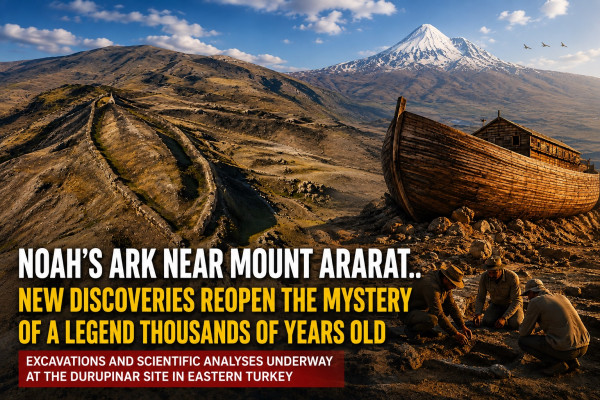
Despite renewed interest in the site, the hypothesis that Noah’s Ark is located within the Durupınar Formation remains scientifically disputed. AI-generated illustrative image.
A research team in eastern Turkey is conducting deep excavations and analysing more than 300 soil samples at the boat-shaped Durupınar Formation, hoping to find physical evidence supporting the theory that the site may be connected to Noah’s Ark. The findings remain subject to scientific investigation and debate.
Ishtar TV
The mystery of Noah’s Ark has once again attracted international media and scientific attention following new research activities at the Durupınar Formation in eastern Turkey, near Mount Ararat.
The unusual geological formation, which resembles the shape of a giant ship when viewed from above, has attracted researchers and explorers since its discovery in 1959.
A report by the American television network Fox News highlighted the latest research, including deep drilling operations and the collection of hundreds of soil samples for laboratory analysis. The research team believes that the findings may provide new information about the site's geological composition and the possibility of ancient organic material beneath its surface.
The Durupınar Formation: A Ship-Shaped Geological Structure
Located in Turkey's Ağrı region, near Mount Ararat, the Durupınar Formation measures approximately 538 feet (164 metres) in length.
Its dimensions have attracted particular attention because they are close to the measurements of Noah's Ark described in the biblical Book of Genesis.
Discovered in 1959, the formation has since become the focus of numerous investigations into the possibility that it could be associated with the biblical account of Noah's Ark.
However, its external shape and dimensions alone are not sufficient to establish that it is an artificial structure or the remains of an ancient vessel.
Deep Drilling and More Than 300 Soil Samples
According to Fox News, the research team, working with Turkish university researchers, conducted an extensive field investigation that included deep drilling operations reaching approximately 20 metres (more than 60 feet) at certain locations.
The team also collected more than 300 soil samples from different depths, both inside and outside the formation.
Andrew Jones, founder of Noah's Ark Scans and vice president of the Noah's Ark Research Project, said that drilling had been carried out at more than 12 locations within the formation.
He also reported that the team had not encountered a continuous solid rock layer in the investigated drilling locations, contrary to what some proponents of the natural geological formation theory might have expected.
The researchers identified dark soil containing organic material and hope that laboratory testing will help determine its composition and whether it contains traces of ancient organic matter, potentially including decomposed wood.
Differences in Soil Composition Attract Researchers' Attention
Some of the team's observations are based on soil samples collected in 2024.
According to the research team, laboratory analyses indicated differences between samples taken from inside the formation and those collected from surrounding areas.
The reported findings included approximately three times more organic material in the internal samples, around 38 per cent higher potassium levels, and differences in acidity.
Researchers believe these variations deserve further investigation, particularly as drilling operations extend deeper beneath the surface.
Nevertheless, the presence of organic material or chemical differences in soil does not, by itself, demonstrate the existence of fossilised timber or the remains of a ship. Further laboratory analysis and independent scientific assessment are necessary.
Ancient Pottery and Nearby Settlements
The Fox News report also discussed ancient pottery fragments reportedly discovered in the vicinity of the Durupınar Formation.
Jones said the fragments require further specialist examination, while preliminary assessments based on their styles suggest a possible chronological range extending from the Early Chalcolithic period to the Iron Age.
The pottery was reportedly found near the formation rather than inside it.
The presence of two ancient settlement sites in the surrounding area was also mentioned as a subject deserving further archaeological investigation.
These discoveries require independent documentation and dating before any conclusions can be drawn about their relationship to the site's history or the biblical account.
Between Religious Tradition and Scientific Interpretation
Despite renewed interest in the site, the theory that the Durupınar Formation represents Noah's Ark remains scientifically disputed.
A study published in 1996 in the Journal of Geoscience Education by geologists Lorence Gene Collins and David Franklin Fasold concluded that the formation is a natural geological structure.
The researchers argued that several features previously interpreted as possible components of a ship could instead be explained by natural geological processes.
Alternative geological interpretations point to the structure of the rocks, sedimentary layers, landslides and erosion processes that have shaped the region.
For the latest findings to constitute convincing archaeological evidence, researchers would need to establish the nature and origin of the samples and publish detailed results subject to independent scientific review.
What Comes Next?
Andrew Jones told Fox News that the team hopes laboratory analyses will provide further evidence relevant to its hypothesis.
The current research is significant because it moves beyond aerial photographs and geophysical surveys towards the collection and examination of physical samples from beneath the formation's surface.
However, demonstrating that the site contains the remains of a man-made vessel, let alone identifying it as Noah's Ark, would require substantial and independently verified archaeological, geological and historical evidence.
For now, the Durupınar Formation remains one of the most intriguing sites associated with the search for Noah's Ark, keeping alive a debate that brings together religious tradition, archaeology and geology.
|