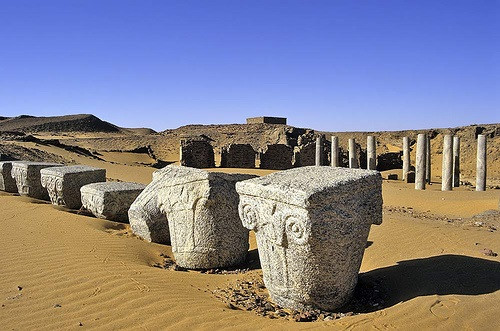
Ruins of the historic North Church in Old Dongola, Sudan, bearing witness to the flourishing of Christianity in the Kingdom of Makuria during the medieval period. Image credit and rights Photo credit: Nubian Image Archive – Wikimedia Commons. Licensed under Creative Commons Attribution 2.0 (CC BY 2.0). Reuse permitted with appropriate attribution.
A joint Polish-Sudanese archaeological mission has reached the original floor level of the Great Church of Jesus for the first time, uncovering a monumental staircase, an upper-floor church and fragments of Greek inscriptions containing part of the Prayer of Hannah.
Ishtar TV - Sudan
New archaeological discoveries in the ancient city of Old Dongola in northern Sudan are revealing important details about the Great Church of Jesus, one of the largest known Christian structures in medieval Nubia.
The discoveries are the result of excavations conducted by archaeologists from the University of Warsaw in cooperation with Sudan’s National Corporation for Antiquities and Museums. The latest work has uncovered a massive staircase, enabled researchers to reach the church’s original floor level for the first time, and revealed a smaller church on an upper floor of an adjoining building.
According to reports published by Polskie Radio on November 5, 2026, the findings provide new insights into the architectural and religious significance of the building, which may have played a central role in the Christian Kingdom of Makuria.
Old Dongola: Capital of a Christian Kingdom
Old Dongola, located along the Nile River in northern Sudan, was the capital of the Kingdom of Makuria, one of the most important Christian kingdoms in medieval Nubia.
Makuria emerged as a Christian kingdom during the sixth century AD and became an important political, religious and cultural centre. Its territory extended along significant stretches of the Nile Valley.
Old Dongola flourished for centuries, developing into a major centre of Christian life, with churches, monasteries, palaces and residential buildings reflecting an advanced architectural tradition.
The city remained an important centre until approximately the fourteenth century, leaving behind a remarkable archaeological heritage that continues to attract international researchers.
The Great Church of Jesus: A Monumental Structure
The Great Church of Jesus is among the largest known medieval Christian buildings in Nubia.
Preliminary measurements indicate that the structure is approximately 47 metres wide and 57 metres long, with a possible height of up to 21 metres.
Some of its walls remain standing at approximately 11 metres, demonstrating the impressive scale of its original architecture.
The research team first identified the building in 2021, and subsequent excavations have gradually revealed its architectural features.
Only part of the structure has been fully excavated, meaning that significant sections remain buried beneath archaeological deposits.
A Monumental Staircase and the Original Floor
One of the most significant discoveries during the latest excavation season was a large staircase leading into the church.
For the first time, archaeologists were able to reach the original floor level of the building in the area of the staircase.
The team also identified architectural supports associated with the eastern apse, the semicircular section traditionally housing the altar in Christian church architecture.
These discoveries are helping researchers understand the building's original layout, construction techniques and internal organisation.
Professor Artur Obłuski, director of the University of Warsaw's Centre of Mediterranean Archaeology and head of the archaeological mission, has suggested that the church may have played an influential role in the development of Christian architecture in Nubia and other parts of Africa.
He has compared its possible architectural influence to that of Hagia Sophia in Constantinople.
Another Church Discovered on an Upper Floor
Another remarkable discovery was a smaller church located on the upper floor of an adjoining building.
Although only about one metre of its walls survives, archaeologists found numerous fragments of painted plaster, indicating that its interior was once decorated with colourful religious artwork.
The team collected a substantial quantity of these fragments, which are now being studied and preserved.
Traces of painted decoration were also identified inside the Great Church of Jesus itself, providing further evidence of the importance of religious art in medieval Nubia.
Greek Inscriptions and Part of the Prayer of Hannah
Among the most significant discoveries are fragments of painted plaster bearing Greek inscriptions.
The texts were examined by Dr Agata Deptuła, a specialist in ancient inscriptions working with the Polish archaeological mission.
Researchers identified fragments of biblical hymns and canticles, including part of the Prayer of Hannah, the mother of the prophet Samuel, recorded in the Old Testament.
The inscriptions are particularly remarkable because some of the Greek letters measure only about half a centimetre in height.
The discovery provides valuable evidence of the use of Greek biblical and liturgical texts in medieval Nubian Christianity.
It also adds to our understanding of the religious traditions, written culture and liturgical practices of the Christian communities that once flourished along the Nile.
Was It the Main Cathedral of the Kingdom?
The enormous size and central location of the Great Church of Jesus have raised important questions about its historical function.
Researchers have considered the possibility that it served as the principal cathedral of Old Dongola and the seat of a senior church authority responsible for a wider ecclesiastical territory.
Earlier interpretations had associated the city's main cathedral with another church located outside its central area.
The discovery of this monumental structure has therefore encouraged archaeologists to reconsider the religious and administrative organisation of the Kingdom of Makuria.
Further excavations and studies will be needed to establish the building's precise historical role.
Archaeological Preservation Amid War and Flooding
The archaeological mission is conducting its work under difficult conditions, as Sudan continues to experience the consequences of civil war.
Old Dongola also suffered severe flooding in autumn 2024, damaging some of the protective roofing structures covering archaeological remains.
Before resuming excavation activities, the mission carried out conservation work in cooperation with the Faculty of Civil Engineering at Warsaw University of Technology.
The team also completed a solar-energy project funded through the Polish Aid programme of Poland's Ministry of Foreign Affairs. The system helps provide electricity for pumps supplying water from the Nile to homes and agricultural fields serving approximately 10,000 local residents.
The project demonstrates how archaeological cooperation can also contribute to protecting heritage and supporting surrounding communities.
Old Dongola: A Major Chapter in African Christian History
The latest discoveries at the Great Church of Jesus highlight the remarkable architectural, religious and cultural achievements of medieval Nubian Christianity.
The monumental building, its painted decorations and Greek biblical inscriptions offer important evidence of the Christian traditions that flourished in Sudan for centuries.
As excavations continue, researchers hope to uncover further details about the church's history, its religious function and its place within the ecclesiastical structure of the Kingdom of Makuria.
Old Dongola remains one of the most important archaeological witnesses to the history of Christianity in Africa.
|