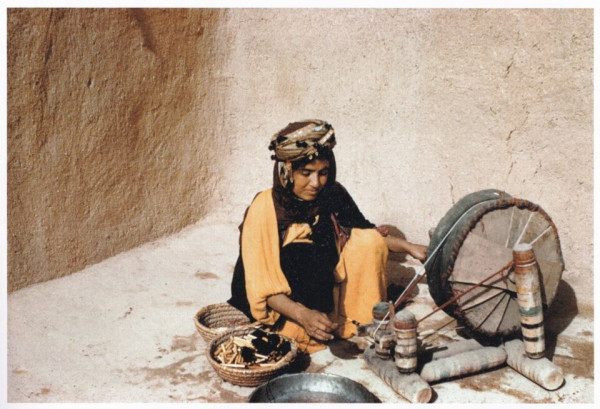
A woman in Ankawa in 1950, spinning wool using a traditional spinning wheel, in a scene documenting aspects of daily life and traditional crafts in old Ankawa. Photo credit: Photographer unknown – Source: Archive Assyria, via Wikimedia Commons. Public Domain (PD Iraq).
A Historical and Social Report
Documenting the Names of Old Family Houses, Family Origins, Traditional
Neighbourhoods and Social Ties That Shaped Ankawa’s Historic Community
Ishtar TV – Ankawa
Ankawa is considered one of the
oldest Christian towns in the Erbil region. Its history is not limited to its
churches and religious and linguistic heritage; it also encompasses a rich
social history shaped over generations by families and traditional family
houses that contributed to the development of the town and the preservation of
its cultural and social identity.
Among the most distinctive
features of this history are the names of families and family houses associated
with Ankawa’s old neighbourhoods, which have become part of the collective
memory of its residents. Family ties, neighbourhood relationships, marriage
connections, agriculture and traditional crafts were all essential elements in
shaping the town’s social life.
Documenting these names has
become particularly important in light of the demographic and urban
transformations Ankawa has experienced over recent decades, including the
expansion of the town, the movement of families and changes in the nature of
social relationships.
1. The Old Clans and Family
Houses of Ankawa
In Ankawa’s collective memory,
terms such as clans, family houses and family branches have traditionally been
used to describe groups connected through kinship, ancestry, marriage or
affiliation with a well-known family house.
Among the names mentioned in
discussions and published recollections by Ankawa residents are:
Plender (پلندر)
Nyati (نياتي)
Siawosh (سياوش)
Abdoka (عبدوكا)
Glyana (گليانا)
Kokna (كوكنا)
Ajmaya (عجمايه)
Konda (كوندا)
Aghna (أغنا)
Ja Jila (جا جيلا)
Askar (عسكر)
Azmat (عظمت)
Husseini (حسيني)
Shangola (شنگولا)
Dakhoka (دخوكا)
Halwaya (حلويا)
Handola (حندولا)
Kaka (ككا)
Qaji (قجي)
Maqdasi (مقدسي)
Bargaw (برغاو)
Yarokaw (يروكاو)
Ali Beg (علي بك)
Malih (مالح)
Shani (شاني)
Baytun (بيتون)
2. Traditional Neighbourhoods and
Old Residential Quarters
Old Ankawa was not simply a
residential settlement; it consisted of neighbourhoods and narrow streets
associated with the names of families, family houses and prominent local
figures.
Among the names preserved in
local memory are:
Darga (درگه).
The Old Church Quarter.
The Association Quarter (الجمعية).
Nabati Quarter (محلة نباتي).
Plender Lane (دربونا پلندر).
Siawosh Quarter (محلة سياوش).
Azmat Quarter (محلة عظمت).
Husseini Quarter (محلة حسيني).
Maqdasi Quarter (محلة مقدسي).
These names reveal the close
relationship between family identities and place. Some streets and residential
areas became associated with the families who lived there or were particularly
well known in those locations.
These neighbourhoods were not
merely geographical divisions; they were also spaces of shared life, social
cooperation, religious celebrations and family gatherings.
3. Families Originating from
Other Towns and Villages
Alongside the old family houses,
Ankawa also became home to families who arrived from other towns and villages,
gradually settling there and becoming part of its social fabric.
Local oral traditions indicate
the presence of families whose names are associated with their places of
origin, including:
The Armota families, associated
with Armota.
The Sinjaq families, associated
with Sinjaq.
The Shaqlawa families, associated
with Shaqlawa.
These names reflect patterns of
migration and settlement among Christian villages and towns in the Erbil
region. They also demonstrate that Ankawa’s community was not limited to a
closed group of families, but developed through kinship, marriage connections
and internal migration.
4. Ankawa in Historical Records
The history of Ankawa’s families
and traditional family houses cannot be studied separately from the history of
the town itself.
Historical sources indicate that
the name Ankawa appeared in different forms throughout the centuries, including
Amkapad and Amku. The historian Bar Hebraeus also mentioned the town in
connection with military events that took place in the Erbil region in 1285 AD.
Some historical studies document
the history of the Church of Mart Shmuni, which gradually became an important
religious centre in the town.
These studies also point to
historical and religious transformations within the Christian communities of
the region, including the gradual adoption of the Chaldean Catholic tradition
by Christians in Erbil and Ankawa, particularly during the eighteenth century.
5. A Book Documenting Ankawa’s
Families and Genealogies
One of the important works that
can be consulted when documenting this aspect of Ankawa’s history is the book
by researcher Farouk Hanna Atto Happi, entitled:
Ankawa in the Memory of Its
People (Ankawa fi Thakirat Abnaiha)
Published in Ankawa in 2017, the
book consists of 292 pages. It covers the town’s history and geography,
folklore, education, culture, arts, historical events and prominent
personalities.
It also includes a dedicated
section on traditional family houses and genealogies, featuring family trees
and documentary photographs.
The importance of this book lies
in the historical material it provides for studying family histories and social
relationships in Ankawa, rather than relying solely on scattered recollections
published in online forums and social media.
6. The Importance of Documenting
Ankawa’s Traditional Family Houses
Documenting the history of
Ankawa’s family houses and families is not simply a matter of recording names;
it is an important effort to preserve the town’s social memory and local
heritage.
Such documentation can contribute
to:
Collecting and recording the
names of old families and traditional family houses.
Documenting family trees and
relationships through historical documents and cross-referenced oral accounts.
Recording the names of old
neighbourhoods and streets and explaining the origins of their names.
Identifying individuals who
contributed to the town’s religious, cultural and social life.
Preserving the oral histories of
elderly residents before an important part of local memory is lost.
Conclusion
The history of Ankawa is written
not only through the history of its churches and institutions, but also through
the history of its homes, families, streets and residents who, over
generations, shaped its social and cultural identity.
The old family houses represent
important chapters in the town’s collective memory. Documenting them is a
cultural and historical responsibility towards future generations, ensuring
that family names, stories and relationships remain an enduring part of the
history of our Chaldean, Syriac and Assyrian people in Ankawa.
Sources and References
Farouk Hanna Atto Happi, Ankawa
in the Memory of Its People, Ankawa, Akila Ink Press, 2017, 292 pages. The book
includes sections on the town’s history, traditional family houses and family
genealogies, along with family trees and documentary photographs.
University of
Kurdistan Hewlêr – Library Catalogue.
Hanna Abdulahad Roufo, A Brief
History of Ankawa: Its Past and Present, Adi Sher Publishing and Media House,
Ankawa, 2003.
WorldCat
– Global Library Catalogue.
Aziz Abdulahad Nabati, The
History of Ankawa, 2000, particularly pages 10–26.
Saadi Al-Malih, Ankawa: Its
Origins, Roots and Other Observations, 1997, pages 9–13.
Hanna Abdulahad Roufo, Archaeological
Sites and Ancient Shrines in Ankawa, Shandar Magazine, Issue No. 4, 1997, pages
87–90.
Hanna Abdulahad Roufo, Ankawa: An
Overview of Its History and Name, Shandar Magazine, Issues 7 and 8, 1998.
Ankawa.com, heritage discussions
and articles concerning the clans, traditional family houses and old
neighbourhoods of Ankawa.
Ankawa Heritage Archive.
Syriac Culture – Bernard Yousif
Ashour, AN-KA'WA: An Analytical Study of the Name Ankawa in Light of Cuneiform
Signs.
Read
the Study.
Kurdistan TV, The Archaeological
Site of Tell Qasra in Erbil, including references to historical sources and
studies addressing Ankawa’s history and archaeology.
Read the Report.
Hadib Association for
Competencies, an article introducing the book Ankawa in the Memory of Its
People and its author, Farouk Hanna Atto Happi.
Read
the Article.
Documentation Note: These
references provide supporting material for research into Ankawa’s history,
heritage and traditional family houses. However, not all the names listed in
this report should be regarded as genealogically established clans without consulting
the relevant pages of the books, as well as family and church records.
|