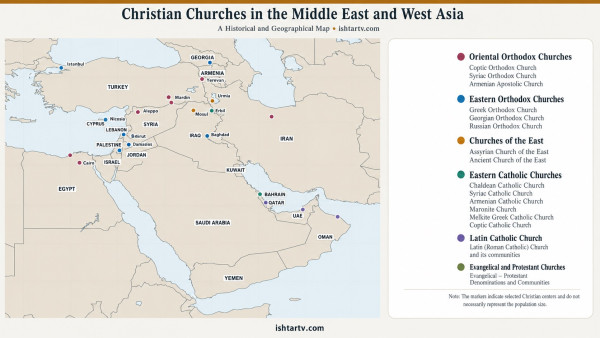
Ishtartv.com – Special Report
The Middle East and West Asia are the historical homeland of Christianity and the region where the earliest Christian churches emerged and developed their theological, liturgical and linguistic traditions before Christianity spread to different parts of the world. Over many centuries, the region has preserved an exceptional ecclesiastical and cultural diversity, encompassing Oriental Orthodox and Eastern Orthodox churches, Eastern Catholic churches, the Churches of the East, as well as Latin Catholic, Evangelical and Protestant churches.
The geographical distribution of these churches reveals a historical presence stretching from Mesopotamia, the Nineveh Plain and Tur Abdin, through the Levant, Jerusalem and Egypt, extending to Armenia, Georgia, Cyprus, Iran and the Arabian Peninsula.
This report aims to provide an extensive overview of these churches, their historical roots and areas of presence, with particular emphasis on the Eastern churches, which constitute an integral part of the history and heritage of the Chaldean Syriac Assyrian people.
First: Oriental Orthodox Churches
This ecclesiastical family includes three major churches in the region: the Coptic Orthodox Church, the Syriac Orthodox Church and the Armenian Apostolic Church.
Historically, these churches are associated with their positions regarding the Council of Chalcedon in 451 AD, and each maintains distinctive theological, liturgical and linguistic traditions.
1. The Coptic Orthodox Church
The Coptic Orthodox Church is the largest Christian church in Egypt. Its history is linked to the tradition that the Church of Alexandria was founded by Saint Mark the Evangelist.
It occupies a central place in Egyptian Christian history, particularly in the development of monasticism, ascetic life and monasteries, while preserving the Coptic language in its prayers and liturgical services.
According to data from the World Council of Churches, the church has an estimated 11 million members in Egypt and one million abroad. These are ecclesiastical estimates rather than figures derived from a recent population census.
2. The Syriac Orthodox Church
The Syriac Orthodox Church is one of the oldest Eastern churches and is historically associated with the See of Antioch, whose patriarchal headquarters are now in Damascus.
Its historical roots extend across Syria, Iraq, Turkey and Lebanon, particularly in the regions of Tur Abdin, Mardin, Hasakah, Qamishli, Mosul and the Nineveh Plain.
The church preserves the Syriac language and its liturgical and literary heritage, including the writings of the Church Fathers, religious poetry, manuscripts and hymns.
3. The Armenian Apostolic Church
The roots of the Armenian Apostolic Church date back to the early centuries of Christianity. Armenia is considered one of the earliest countries to adopt Christianity as its official state religion, in 301 AD, according to the church's historical tradition.
The Catholicosate of Etchmiadzin in Armenia is its principal spiritual centre, while the Catholicosate of the Great House of Cilicia, headquartered in Antelias, Lebanon, represents one of the church's major sees.
The church has a historical presence in Armenia, Turkey, Lebanon, Syria, Iran and Cyprus, as well as in Jerusalem.
Sources: Armenian Apostolic Church and World Council of Churches.
Second: Eastern Orthodox Churches
This ecclesiastical family differs historically and theologically from the Oriental Orthodox churches, as it accepts the decisions of the Council of Chalcedon in 451 AD.
Among its most prominent churches in the region are:
1. The Greek Orthodox Church
This church is associated with three important historical patriarchal sees:
-
The Greek Orthodox Patriarchate of Antioch and All the East, headquartered in Damascus.
-
The Greek Orthodox Patriarchate of Jerusalem.
-
The Greek Orthodox Patriarchate of Alexandria and All Africa.
The church has a presence in Syria, Lebanon, Jordan, Palestine, Israel, Egypt and Turkey.
It is one of the major components of Arab Christian communities in the Levant, using Arabic in most of its services, alongside Greek in certain liturgical traditions.
2. The Georgian Orthodox Church
The Georgian Orthodox Church is the principal historical church in Georgia and plays a central role in the country's religious and cultural identity.
Its roots date back to the early centuries of Christianity. It is distinguished by its liturgical traditions, Georgian language, ecclesiastical architecture and historic monasteries.
Other Christian communities are also present in Georgia, including the Armenian Apostolic Church, the Catholic Church and Evangelical churches.
Source: State Agency for Religious Issues of Georgia.
3. The Russian Orthodox Church
The Russian Orthodox Church's presence in the Middle East is rooted in historical and religious ties with the Holy Land, particularly Jerusalem.
It maintains a presence in Jerusalem, Israel, Palestine and other countries in the region. Russian Orthodox communities are also found among expatriate populations in some Gulf countries.
It is important to distinguish between Russian Orthodox congregations and local Orthodox churches, such as the Greek Orthodox Patriarchate of Antioch and the Georgian Orthodox Church.
Third: The Churches of the East with an East Syriac Tradition
The Churches of the East occupy a special place in the history of Christianity in Mesopotamia. Their traditions emerged and developed within the civilizational environment of Mesopotamia and Persia, and they played a significant role in spreading Christianity to vast regions of Asia.
1. The Assyrian Church of the East
The Assyrian Church of the East is one of the oldest historical churches in the region. Its roots are associated with the See of Seleucia-Ctesiphon in Mesopotamia.
Historically, it enjoyed a widespread presence in Iraq and Iran, and its missionary activities extended to India, Central Asia and China.
The church preserves its East Syriac rite and its liturgical and linguistic heritage. Today, it maintains a presence in Iraq, Syria and Iran, in addition to its worldwide diaspora.
2. The Ancient Church of the East
The Ancient Church of the East is an independent church, separate from the Assyrian Church of the East. Its history is associated with the ecclesiastical division that took place during the 1960s.
It has a presence in Iraq, particularly among Assyrian communities in Baghdad and the Kurdistan Region, as well as congregations in diaspora countries.
It is important to represent this church separately on the map and not automatically merge it with the Assyrian Church of the East, despite their shared historical roots and East Syriac liturgical tradition.
Fourth: Eastern Catholic Churches
Eastern Catholic churches are united with the Catholic Church through communion with the Holy See in Rome, while retaining their own rites, traditions and distinctive ecclesiastical and liturgical structures.
The region is home to several historic Eastern Catholic churches.
1. The Chaldean Catholic Church
The Chaldean Catholic Church is one of Iraq's most important historical churches, with roots connected to the Church of the East in Mesopotamia.
Its historical centres include Mosul, the Nineveh Plain, Erbil, Baghdad and other parts of Iraq. It also has a presence in Iran, Syria, Lebanon and diaspora countries.
The Chaldean Patriarch has his seat in Baghdad. The church is distinguished by its East Syriac rite and its liturgical and literary heritage.
This church occupies a central position in the history of the Chaldean Syriac Assyrian people.
2. The Syriac Catholic Church
The Syriac Catholic Church traces its roots to the Syriac Antiochene tradition. It preserves the West Syriac rite and the Syriac language in its prayers and liturgical services.
It has a historical presence in Syria, Iraq, Lebanon and Turkey, with communities in Mosul, Qaraqosh, Bartella, Hasakah and other areas.
3. The Maronite Church
The Maronite Church is one of the most prominent Eastern Catholic churches. Its history is associated with Saint Maron and monastic life in the Levant.
Its principal historical and demographic centre is Lebanon, particularly Mount Lebanon and the Qadisha Valley, with an extended presence in Syria, Cyprus and diaspora communities.
It is distinguished by its West Syriac Antiochene rite and its spiritual and liturgical heritage.
4. The Melkite Greek Catholic Church
The roots of this church lie in the Byzantine tradition. It is in communion with Rome and preserves the Byzantine rite.
Its presence is concentrated in Syria and Lebanon, with communities in Jordan, Palestine, Israel and Egypt, as well as other countries.
5. The Armenian Catholic Church
The Armenian Catholic Church represents an Eastern Catholic tradition that uses the Armenian rite.
It has a presence in Lebanon, Syria, Iraq, Iran, Turkey and Egypt, as well as communities in diaspora countries.
6. The Coptic Catholic Church
The Coptic Catholic Church is primarily based in Egypt and preserves the Coptic tradition and rite within the Catholic communion.
It has congregations in Cairo, Alexandria, Upper Egypt and other areas.
Fifth: The Latin Catholic Church
The Latin-rite Catholic Church is present in various countries across the region, with a particularly significant historical presence in Jerusalem and the Holy Land.
The Latin Patriarch of Jerusalem is one of the most prominent ecclesiastical leaders in the region. The church serves local and expatriate communities in Palestine, Israel, Jordan, Cyprus, Lebanon, Syria, Iraq and Iran.
In the Gulf countries, expatriate Christian workers constitute a significant proportion of Catholic congregations. Consequently, their numbers should not be considered an indication of the size of indigenous Christian communities.
Data from the United States Conference of Catholic Bishops indicates that the Latin Catholic presence in the Arabian Peninsula is largely associated with expatriate workers from Asia and Africa.
Sixth: Evangelical and Protestant Churches
Evangelical and Protestant churches expanded their presence in the region during the nineteenth and twentieth centuries as a result of missionary activities and social and educational developments.
These churches include:
They have a presence in Egypt, Lebanon, Syria, Iraq, Jordan, Palestine, Israel, Iran, Turkey, Georgia, Armenia, Cyprus, Kuwait and other Gulf countries.
The region is home to historic Evangelical institutions, including the Evangelical Synod of Egypt, the National Evangelical Synod of Syria and Lebanon, the Evangelical Church in Iran, and the Lutheran Church in Jordan and the Holy Land.
Seventh: Geographical Distribution of Churches by Country
Iraq
Iraq is home to a wide range of historic churches, most notably:
-
The Chaldean Catholic Church.
-
The Assyrian Church of the East.
-
The Ancient Church of the East.
-
The Syriac Orthodox Church.
-
The Syriac Catholic Church.
-
The Armenian Apostolic and Armenian Catholic Churches.
-
The Greek Orthodox Church.
-
The Latin Catholic Church.
-
Evangelical and Protestant churches.
-
The Coptic Orthodox Church.
Baghdad, Mosul, the Nineveh Plain, Erbil and Duhok are among the most important centres of Christian presence.
Syria
Syria is home to:
-
The Greek Orthodox Church.
-
The Syriac Orthodox Church.
-
The Syriac Catholic Church.
-
The Armenian Orthodox Church.
-
The Armenian Catholic Church.
-
The Melkite Greek Catholic Church.
-
The Maronite Church.
-
The Chaldean Catholic Church.
-
The Assyrian Church of the East and the Ancient Church of the East.
-
Latin Catholic and Evangelical churches.
Damascus, Aleppo, Hasakah, Qamishli and the regions of the Syrian Jazira are among the most prominent historical centres.
Lebanon
Lebanon is distinguished by its extensive ecclesiastical diversity and includes:
-
The Maronite Church.
-
The Greek Orthodox Church.
-
The Melkite Greek Catholic Church.
-
The Armenian Orthodox Church.
-
The Armenian Catholic Church.
-
The Syriac Orthodox Church.
-
The Syriac Catholic Church.
-
The Chaldean Church.
-
Latin Catholic and Evangelical churches.
-
Jordan, Palestine and Israel
These areas are home to:
-
The Greek Orthodox Church.
-
Latin Catholics.
-
The Melkite Greek Catholic Church.
-
The Armenian Orthodox Church.
-
The Armenian Catholic Church.
-
The Syriac Orthodox Church.
-
The Coptic Orthodox Church.
-
The Maronite Church.
-
Anglican, Lutheran and Evangelical churches.
Jerusalem, Bethlehem, Nazareth, Madaba and Amman are important centres of this diversity.
Egypt
The Coptic Orthodox Church is the largest Christian church in the country, alongside:
-
The Coptic Catholic Church.
-
The Greek Orthodox Church.
-
The Armenian Orthodox Church.
-
The Armenian Catholic Church.
-
The Latin Catholic Church.
-
Evangelical and Protestant churches.
Turkey
The country's historic churches include:
-
The Armenian Orthodox Church.
-
The Greek Orthodox Church.
-
The Syriac Orthodox Church.
-
The Syriac Catholic Church.
-
The Chaldean Catholic Church.
-
The Assyrian Church of the East.
-
The Armenian Catholic Church.
-
Latin Catholic and Evangelical churches.
Istanbul, Mardin, Tur Abdin and Antioch are among the most prominent historical areas.
Iran
Iran is home to:
-
The Armenian Apostolic Church.
-
The Assyrian Church of the East.
-
The Chaldean Catholic Church.
-
The Armenian Catholic Church.
-
Evangelical and Presbyterian churches.
-
The Latin Catholic Church.
Tehran, Isfahan and Urmia are among the most important historical centres.
The World Council of Churches indicates that the Armenian Apostolic Church represents the largest Christian community in Iran, alongside a historic Assyrian presence dating back to the early centuries.
Armenia
The Armenian Apostolic Church is the country's principal church, alongside:
Georgia
The Georgian Orthodox Church is the country's principal historical church, alongside:
-
The Armenian Apostolic Church.
-
The Latin Catholic Church.
-
The Evangelical Lutheran Church.
-
Baptist and Protestant churches.
-
Cyprus
Cyprus is home to:
-
The Orthodox Church of Cyprus.
-
The Armenian Apostolic Church.
-
The Maronite Church.
-
The Latin Catholic Church.
-
Anglican and Evangelical churches.
The Gulf Countries
The Gulf countries have a diverse Christian presence, encompassing Catholic churches, Eastern and Oriental Orthodox churches, Protestant and Evangelical communities.
Churches and places of worship are found in Bahrain, Kuwait, Qatar, the United Arab Emirates and Oman, although the nature of Christian presence and the legal and regulatory circumstances vary from one country to another.
An academic study on Christianity in the Gulf published in 2026 indicates that most Christians in the Gulf countries are expatriate workers, and that the region historically witnessed a Syriac Christian presence dating back to the early centuries.
Eighth: Migration, Demographic Decline and Challenges in Preserving Heritage
Christian communities in the Middle East have faced significant challenges over recent decades, including wars, conflicts, migration, and political and economic changes.
The consequences of ISIS's takeover of large areas of Iraq in 2014 were among the most significant events to directly affect Christian presence, particularly in Mosul and the Nineveh Plain.
In Syria, years of conflict led to the displacement of large numbers of Christians and a decline in the presence of some historic communities.
Christian communities in Turkey and Iran also face challenges related to preserving their religious and heritage institutions, while Christian communities in the Gulf are largely associated with migration and expatriate labour.
Protecting churches, monasteries, manuscripts, cemeteries, schools, cultural institutions and the Syriac, Armenian, Coptic and Greek languages remains among the most important requirements for safeguarding the region's Christian heritage.
Conclusion
The map of Christian churches in the Middle East and West Asia reveals a historical and religious diversity that cannot be reduced to a single church or denomination in each country.
From the Church of the East in Mesopotamia to the Syriac churches of the Levant and Tur Abdin, from the Coptic Church in Egypt to the Armenian churches of the Caucasus and the Middle East, and from the Antiochene, Jerusalem and Alexandrian traditions to the Eastern Catholic, Latin Catholic and Evangelical churches, this region represents a living record of the history and development of Christianity.
Preserving this diversity remains a historical and cultural responsibility, one that extends beyond ecclesiastical institutions to include governments, societies, and cultural and media institutions committed to safeguarding our shared human heritage.
Note: The geographical markers indicate selected Christian centres. They do not necessarily mean that the church identified is the largest or the only church in that country, nor do they represent a statistical distribution of the number of adherents of each church.