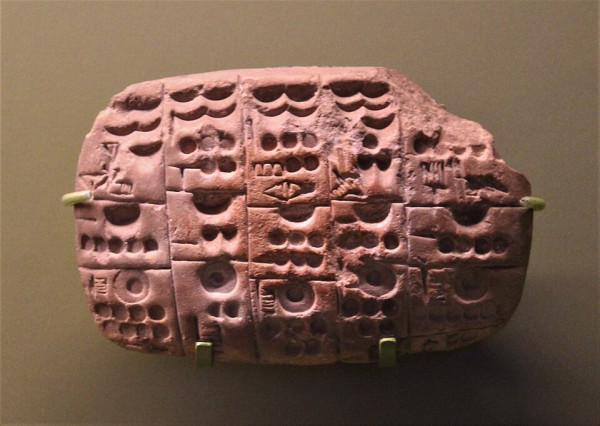
OXFORD (IshtarTV.com) - Five thousand years ago, humanity did not rely on computers or complex software to manage resources; instead, ancient Iraqis devised a sophisticated accounting system mirroring the precision and methodology of modern spreadsheet programs like Microsoft Excel, sparking a true administrative revolution in the heart of Mesopotamia.
According to archaeological reports and educational publications recently issued by the Ashmolean Museum at the University of Oxford, and followed closely by IshtarTV.com, the clay tablet discovered at the Jemdet Nasr archaeological site in southern Iraq (dating back to 3200–2900 BCE) stands as one of the most significant historical documents shedding light on the origins of management and mathematics.
Field of the EN: Utmost Mathematical Precision
The Sumerian tablet preserved at the museum bears the archive designation (AN1926.583) and records remarkably advanced administrative operations. Known among archaeological circles as the "Field of the EN," the tablet is notable not only for employing a very early form of cuneiform script, but also for relying on specific mathematical symbols—namely "circles and half-circles"—to signify numbers and quantities. The Sumerian scribe used these symbols to calculate the areas of five distinct agricultural fields with extreme accuracy, summed the total areas into a grand total, and subsequently divided the final result.
A Hierarchical and Stratified Economy
Beyond serving as a mere clay calculator, the tablet offers a rare sociological and economic record of early Sumerian social structure. Cuneiform translations reveal that the grand total of the field areas was mathematically split into thirds: "two-thirds" of the total were allocated to an influential figure holding the title "EN"—a Sumerian term meaning "lord," "ruler," or "leader"—while the remaining third was distributed unequally among other individuals, including the EN's wife.
From Clay to Modern Management
Archaeological experts confirm that this strict and methodical allocation clearly reflects the hierarchical and class-structured nature of that era, where authority and resources were concentrated in the hands of high leadership (the EN). Furthermore, the tablet proves that the Sumerians of Jemdet Nasr invented a spatial data organization system (dividing the tablet into cells and fields akin to Excel grid cells) to record and distribute commodities, livestock, and labor while safeguarding property rights—establishing southern Iraq as the first cradle of institutional management in human history.