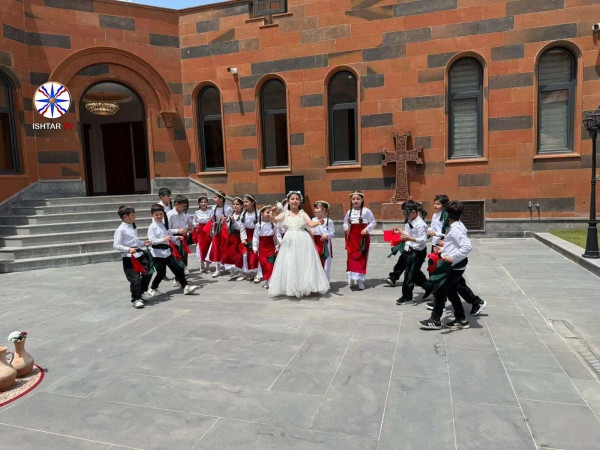
Students of Al-Ittihad School and the Armenian Dance Group celebrating in the courtyard of the Armenian Orthodox Church of the Virgin Mary in Zakho on the occasion of the Feast of the Ascension of Jesus Christ, 15 May 2026. Photo credit: IshtarTV.com.
IshtarTV.com – History of Iraq
From historical roots dating back to ancient times, through waves of migration and settlement during the Ottoman era and the twentieth century, to the present day, Armenians have formed an integral part of Iraq’s social, cultural, and economic fabric.
The history of Armenians in Iraq extends across successive historical periods. Their presence was not merely the result of modern migration or events of the twentieth century, but was connected to ancient relations between Mesopotamia and the Armenian Highlands. These ties were strengthened over time through trade, travel, and settlement, before a clearly defined Armenian community emerged in Baghdad, Mosul, Basra, and other Iraqi cities.
Armenians have contributed to Iraqi life in the fields of industry, commerce, education, the arts, medicine, and craftsmanship. At the same time, they have preserved their language, heritage, Church, and cultural institutions, making their history an integral part of Iraq’s religious and ethnic diversity.
First: Historical Roots and Ancient Relations
Historical Armenia lies north of Mesopotamia, and the two regions have maintained geographical, commercial, and political relations since ancient times. Names and regions associated with Armenia appear in texts and sources from the ancient civilizations of the Near East. Goods and merchants also moved between the Armenian Highlands and Mesopotamian cities through land and river trade routes.
A study entitled “An Overview of the History of the Armenian Presence in Iraq” by researcher Sina Ohanian, from the Institute of History at the Armenian Academy of Sciences in Yerevan, indicates that research into the Armenian presence in Mesopotamia is connected to a long history of interaction between the two regions.
However, it is important to distinguish between the antiquity of these historical relations and evidence of a continuously established Armenian community in Iraq in the institutional sense that emerged later. The clearest evidence of organized Armenian communities appears in subsequent historical periods.
Second: Settlement in Baghdad and Basra During the Seventeenth and Eighteenth Centuries
Armenian migrations during the seventeenth century represent an important milestone in the formation of the Armenian community in Iraq.
The Embassy of the Republic of Armenia in Baghdad states that some Armenians who had moved to Iran during the reign of Shah Abbas I and settled in New Julfa in Isfahan later headed towards Iraq and India, while some settled in Basra instead of continuing their journey to India.
Other Armenian groups arrived from regions such as Diyarbakir, Urfa, Adana, and Izmir, settling in Iraqi cities, particularly Baghdad and Basra.
Historical sources indicate that the Armenians of Basra were ecclesiastically affiliated with the Diocese of Isfahan, while the Armenians of Baghdad were connected to the See of Etchmiadzin in Armenia.
As these communities grew, the Armenian presence was no longer limited to individuals engaged in trade. It began to develop into an organized social and religious community through churches, associations, and educational institutions.
Third: Armenians in Mosul and Northern Iraq
Mosul also witnessed a significant Armenian presence, with the beginnings of its modern community dating back to the nineteenth century.
According to researcher Aspet Kouchikian in a study published by the Armenian General Benevolent Union (AGBU), a small Armenian church was built in Mosul around 1860, commissioned by the Armenian Patriarch of Constantinople.
In northern Iraq, the Armenian presence was also associated with cities and towns such as Zakho, Duhok, and Kirkuk, as well as Armenian villages in the region, including Hawresk and Avzrog.
Family and religious ties helped these communities survive despite the wars and political transformations that affected the region.
Fourth: The Armenian Genocide of 1915 and the Arrival of Survivors in Iraq
The Armenian Genocide during the First World War marked a major turning point in the history of the Armenian community in Iraq.
Following the deportations and massacres suffered by Armenians in the Ottoman Empire, large numbers of survivors arrived in Iraqi territories from Anatolia and its eastern regions, as well as from other areas such as Urmia.
The Armenian Embassy in Baghdad indicates that tens of thousands of Armenians migrated to Iraq as a result of the events of 1915. According to its estimates, the number of Armenians residing in the country during the 1920s reached approximately 90,000.
However, this figure reflects the period of refugee arrivals and does not mean that all of them settled permanently. Some returned to Armenia, while others moved to different countries.
The city of Baqubah was among the locations associated with Armenian refugee camps, while others settled in Baghdad, Basra, and Mosul.
An AGBU study mentions that Levon Shaghoyan, known as “Levon Pasha,” led a group of Armenians to Iraq following the withdrawal of Russian forces from the Ottoman front in 1917. Some settled in Mosul, while others lived in refugee camps in Baqubah.
By the end of the 1920s, a large number of refugees had moved to Baghdad, Basra, Syria, and Iran, while other groups settled in northern Iraq and contributed to the establishment of Armenian communities in Zakho, Hawresk, and Avzrog.
Fifth: Armenian Churches – The Memory and Centre of Community Identity
The Church has occupied a central place in the lives of Armenians in Iraq. It has served not only as a place of worship but also as an institution for preserving language, identity, and traditions, organizing community affairs, and providing social and educational support.
Baghdad is home to several Armenian churches, the most prominent of which is the Church of St. Gregory the Illuminator, which has become one of the most important landmarks of the Armenian presence in the capital.
The history of Armenians in Baghdad is also associated with the Church of the Virgin Mary in the Maydan district and the Holy Trinity Church in Shorja, which was built in the nineteenth century and demolished in 1957 because of damage to its structure.
In Basra, the Church of the Virgin Mary was built in the eighteenth century, while Mosul witnessed the establishment of the Holy Etchmiadzin Church in the nineteenth century.
Armenian churches were also established in Kirkuk, Zakho, and other areas of northern Iraq.
The Armenian Embassy states that the Diocese of the Armenian Orthodox Church in Iraq is affiliated with the See of Etchmiadzin and includes churches in Baghdad and other Iraqi cities.
Alongside the Armenian Orthodox community, there is also an Armenian Catholic community with its own churches and religious institutions.
Sixth: Education and Armenian Schools in Iraq
Education was one of the most important fields through which Armenians preserved their cultural identity while simultaneously contributing to Iraq’s educational life.
Armenian churches established private schools to teach Armenian, Arabic, and foreign languages, alongside religious subjects, sciences, and literature.
An academic study by Dr. Ali Mohammed Karim Al-Mashhadani, published in the University of Baghdad’s Journal of Studies in History and Archaeology, examines Armenian education in Iraq from the mid-nineteenth century until 1974.
The study explains that Armenian Orthodox and Catholic churches contributed to establishing and supporting schools, and that Armenian educational institutions offered curricula covering Armenian and Arabic languages, foreign languages, scientific subjects, and the humanities.
The institutions discussed in the study include Armenian private schools, the Armenian Catholic School, Armenian Eastern and Western schools, and the School of the Sisters of Mary for Armenian Catholics.
These schools helped generations of community members maintain their mother tongue while integrating into Iraqi society. They also contributed to educating individuals who went on to work in medicine, engineering, administration, and commerce.
Seventh: Associations, Sports, and Cultural Life
Armenian institutions in Iraq were not limited to churches and schools. They also included charitable, cultural, sporting, and youth associations that played an important role in strengthening community bonds.
Among the most prominent institutions were the Armenian General Benevolent Union, the Armenian Youth Association, the Armenian sports club Homenetmen, the Armenian Women's Cultural Association, and the Martyr Ohan Sports Club.
These institutions helped organize social, theatrical, musical, and sporting activities, strengthen communication between generations, and provide assistance to families in need.
The Armenian Embassy lists these associations among the institutions that continue to represent part of Armenian community life in Iraq.
Eighth: Armenians in Iraq During the Monarchical and Republican Eras
Following the establishment of the modern Iraqi state in 1921, the Armenian community began reorganizing its social, religious, and educational life, and its institutions expanded in Baghdad, Basra, Mosul, and Kirkuk.
Despite the different origins of the Armenian families who settled in Iraq, they found Iraqi cities to be an environment in which they could pursue commerce, crafts, and various professions.
Community members worked in numerous fields, including gold and jewellery making, tailoring, photography, trade, medicine, and engineering. They also became involved in government employment and cultural life.
The following decades witnessed increased activity in establishing associations, schools, and clubs, with Baghdad becoming a major centre of Armenian life in the country.
The Armenian Embassy states that the Armenian population in Iraq reached approximately 25,000 before 2003, most of whom lived in Baghdad, with communities in Mosul, Basra, Kirkuk, and other cities.
Ninth: Wars, Migration, and the Decline in the Armenian Population
The Armenian community, like other components of Iraqi society, was affected by the wars and political, economic, and security crises that Iraq experienced.
The Iran-Iraq War, the Gulf War, and difficult economic conditions prompted a number of families to migrate to neighbouring countries, Europe, the United States, Canada, and Australia.
After 2003, waves of migration increased as a result of deteriorating security conditions and attacks targeting Christians. Some churches and Christian institutions were also subjected to attacks.
A number of Armenians moved from Baghdad, Mosul, and other cities to the Kurdistan Region, particularly Erbil, Duhok, and Zakho, in search of safer conditions.
In June 2014, the takeover of Mosul by ISIS triggered another wave of displacement, severely affecting Christian life in the city, including the Armenian presence, which had a long history there.
A study entitled “The Forgotten Armenians of Iraqi Kurdistan,” published by Aspet Kouchikian on the website of the Armenian General Benevolent Union (AGBU), explains that some Armenians displaced from Mosul moved to Erbil and Duhok. Some were forced to hold their prayers in churches belonging to other Christian communities because no dedicated Armenian church was available in the region at the time.
Tenth: Armenians in the Kurdistan Region and Armenian Villages
The Kurdistan Region represents an important chapter in the history of the Armenian presence in Iraq, both through historical communities in the north of the country and through waves of migration and displacement during recent decades.
Among the most prominent locations associated with Armenian history in the region are:
Zakho: Armenian families settled in the city, which is home to an Armenian church dedicated to the Virgin Mary.
Hawresk: A village associated with the settlement of Armenian families after the First World War.
Avzrog: A village with a shared Armenian and Assyrian presence, considered one of the well-known locations in the history of Armenian communities in northern Iraq.
Duhok and Erbil: These cities received Armenian families who moved from other Iraqi cities, particularly after 2003 and the events of 2014.
The AGBU study indicates that Armenian villages in northern Iraq underwent major transformations. In 1975, the villages of Hawresk and Avzrog were evacuated as part of resettlement operations affecting villages in Kurdistan, and their residents moved to neighbouring areas and towns.
Eleventh: Armenians in the Iraqi Constitution and the Rights to Language and Identity
The Armenian language has received constitutional recognition among the languages in which Iraqis have the right to educate their children in government educational institutions, in accordance with educational regulations.
Article 4 of the 2005 Iraqi Constitution stipulates that Arabic and Kurdish are the official languages of the state. It also guarantees the right of Iraqis to educate their children in their mother tongue, including Turkmen, Syriac, and Armenian, in government educational institutions in accordance with the specified regulations, or in any other language in private educational institutions.
This provision represents an important constitutional foundation for protecting the Armenian language and ensuring the continuation of its teaching in Iraq, alongside guaranteeing the religious and cultural rights granted to citizens under the Constitution.
Twelfth: Armenian Orthodox, Catholic, and Evangelical Communities in Iraq
Armenians in Iraq belong to different church affiliations, most notably the Armenian Apostolic Church and the Armenian Catholic Church, alongside the presence of an Armenian Evangelical community.
The Armenian Apostolic Church, affiliated with the See of Etchmiadzin in Armenia, is the principal religious institution for a large segment of Armenians in Iraq.
Armenian Catholics have their own institutions and churches, most notably the Church of Our Lady of Flowers and the Sacred Heart Church in Baghdad.
The Armenian Embassy states that the Church of Our Lady of Flowers was built in 1844, while the Sacred Heart Church was built in 1937. The main Armenian Catholic church in Baghdad was rebuilt in 1997.
It also indicates that a number of Armenian Catholic families continue to live in Iraq.
Thirteenth: How Many Armenians Live in Iraq Today?
Published estimates of the number of Armenians living in Iraq vary because of continued migration, declining populations in some communities, and the difficulty of conducting an independent and accurate census of the community.
According to the Armenian community page on the official website of the Embassy of the Republic of Armenia in Baghdad, the number of Armenians in Iraq is estimated at approximately 13,000.
Meanwhile, the international organization Minority Rights Group International indicates that some reports place the remaining population at fewer than 8,000.
The Society for Orphaned Armenian Relief (SOAR) also provides an estimate of approximately 10,000 Armenians, with communities in Baghdad, Mosul, Basra, Kirkuk, and Duhok.
The differences between these figures reflect the difficulty of determining the current population with certainty. Nevertheless, they confirm the continued presence of the Armenian community in Iraq despite its significant decline compared with previous decades.
Fourteenth: Armenian Contributions to Iraqi Society
Armenians in Iraq have not simply been a community that preserved its religious and cultural heritage. They have also been part of public life and contributed to numerous fields, including:
Trade and Industry: Armenian families became prominent in commerce, crafts, and traditional industries, particularly gold and jewellery making and handicrafts.
Education: Armenian schools contributed to the spread of education and graduated generations proficient in Armenian, Arabic, and foreign languages.
Medicine and Engineering: A number of community members worked in scientific professions and medical and engineering specializations.
Arts and Culture: Armenians were active in music, theatre, photography, and cultural activities, preserving their artistic heritage within Iraq.
Sports: Armenian clubs, including Homenetmen, contributed to sporting and social activities and strengthened bonds among young people.
The University of Baghdad study on Armenian education confirms that church and educational institutions played a central role in building the community's cultural life, while the Armenian Embassy documents the continued existence of Armenian sporting, cultural, and charitable associations in Iraq.
Conclusion: Armenians Are Part of Iraq's History and Diversity
The history of Armenians in Iraq is a story of a human and cultural presence extending across centuries and intertwined with the history of Iraqi cities and their communities.
From the merchants who settled in Basra and Baghdad, to the survivors who arrived following the Armenian Genocide of 1915, and the generations born and raised in Iraq, Armenians have remained part of Iraqi society and one of its religious and cultural components.
Despite the migration, population decline, and security challenges faced by the community, its churches, schools, associations, and villages with Armenian roots continue to bear witness to its history. The continued use of the Armenian language, along with church celebrations and traditions, represents the continuation of the collective memory of a community that has contributed to building Iraqi life.
Preserving this heritage is not solely a matter concerning Armenians. It is also part of safeguarding Iraq's diverse history and protecting the legacy of its communities, whose landmarks, institutions, and traditions have helped shape the country's cultural and social identity.
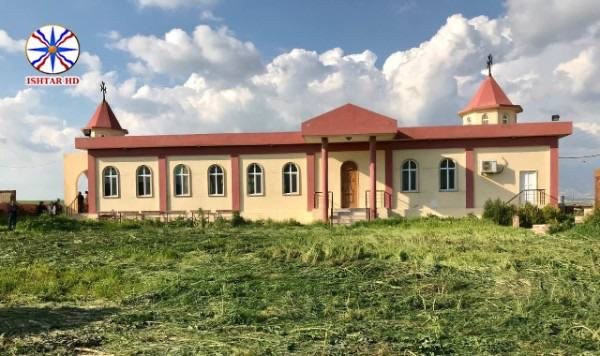
The Church of Saint Sarkis in the Armenian village of Hawresk. Photo credit: IshtarTV.com.
|