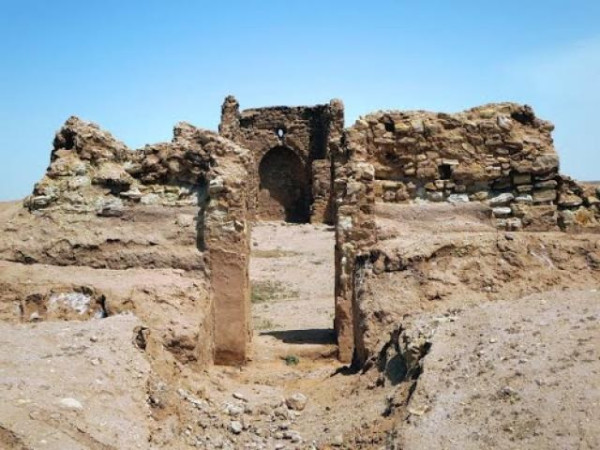
The ruins of Al-Ukhaidir Church (one of the oldest churches in Iraq, dating to the fifth century AD), located in Ain al-Tamr District, west of Karbala Governorate. The image is available for free use under a Creative Commons Attribution-ShareAlike (CC BY-SA) licence. Publication requires attribution to the original source: Archiqoo / Wikimedia Commons.
Special – IshtarTV.com
At a time when Middle Eastern Christians face an existential threat that could lead to their disappearance from their historic homelands, their fate appears to be almost entirely absent from coverage by Western and Swedish media outlets. In a rare effort to draw attention to this tragedy, Swedish writer and political editor Adam Cwejman published a highly significant editorial in the newspaper Göteborgs-Posten, sounding the alarm over the future of the Christian presence in the region.
Alarming Demographic Decline
In his article, Cwejman drew on figures and statistics documenting the dramatic demographic decline of Christians. In 1910, Christians were estimated to account for approximately 13.6% of the total population of the Middle East. Just one hundred years later, that proportion had fallen to 4.2%.
The writer explained that these communities are not newcomers to the region, but belong to some of the world's oldest Christian churches and denominations, including the Coptic Church, the Maronite Church, the Melkite Greek Catholic Church, and the Armenian Apostolic Church. The roots of many of these communities extend back to the earliest days of Christianity, several centuries before the advent of Islam, preserving through their rites and traditions a living legacy of some of the oldest Christian traditions.
The report attributed this sharp decline to successive periods of genocide, ethnic cleansing campaigns, devastating wars, continuous waves of emigration, and declining birth rates, all of which have devastated Christian communities and tragically reduced their populations.
Media Silence and a One-Sided Narrative
In a sharp criticism of Western awareness, Cwejman expressed surprise that all these major events, which took place throughout the twentieth century and the first decades of the twenty-first, have been almost entirely neglected and forgotten in the Western world, which is still predominantly considered a "Christian world." He stressed that this tragedy should have received far greater attention in historical memory.
As for the reasons behind this neglect, the Swedish writer offered what he described as a simple but unfortunate explanation: the media, particularly in Sweden, often approach the history and reality of the Middle East through a narrow, one-sided perspective focused almost entirely on the Israeli-Palestinian conflict.
Cwejman concluded his article with a warning that, under this dominant historical and media narrative, the history of Christians—and that of other religious and ethnic minorities—has no room or place. As a result, two thousand years of an indigenous Christian presence have been reduced to a forgotten tragedy that remains outside media coverage.
|