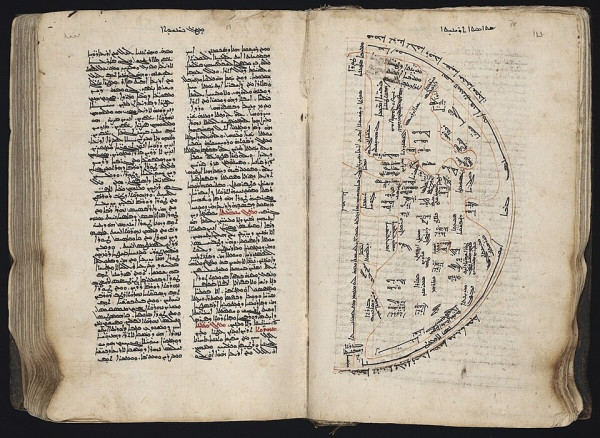
A manuscript of one of Bar Hebraeus’s works, showing a map of the world within the text. Source: Beinecke Rare Book and Manuscript Library, Yale University, via Wikimedia Commons. Image rights: Public Domain.
IshtarTV.com – Special Report
Mar Gregorios Abu al-Faraj Bar Hebraeus (1226–1286 AD) is regarded as one of the most prominent figures in the Syriac heritage of the Middle Ages and one of the most prolific and versatile scholars in the history of the Middle East. He combined ecclesiastical service with historical writing, theological research, philosophy, medicine, linguistics, and astronomy, leaving behind works that became important references for the study of the history of Eastern Churches and civilization in the Middle East.
Bar Hebraeus’s significance was not limited to his religious standing as a bishop and later Maphrian of the Syriac Orthodox Church in the East. It also extended to his role in preserving a substantial body of knowledge shared by Syriac, Arabic, and Greek cultures, and presenting it anew in encyclopedic works whose influence has continued to be felt among researchers into the modern era.
Early Life, Name, and Scholarly Beginnings
Bar Hebraeus was born in the city of Melitene, located in present-day Turkey, in 1225 or 1226 AD, into a Syriac Christian family. His baptismal name was John, and he later adopted the name Gregory when he was consecrated as a bishop. His familiar name, “Ibn al-Ibri” or “Bar Ebroyo” in Syriac, has been associated with two historical explanations. However, researcher Herman Teule, writing in the Encyclopaedia Iranica, favors the explanation that the name derives from the village of “Ebro,” located on the Euphrates River, from which his family originated, rather than from Jewish ancestry, as the name has sometimes been interpreted. This explanation is also supported by the entry on Bar Hebraeus in the Gorgias Encyclopedic Dictionary of the Syriac Heritage, published by Gorgias Press.
Bar Hebraeus grew up in a family with a strong interest in learning. His father, Aaron, was a physician who introduced him to medicine and the sciences during his early years. He subsequently continued his studies in Antioch and Tripoli, where he became acquainted with a wide range of religious, philosophical, medical, and linguistic disciplines. This diverse education helped shape his scholarly character, which was never confined to a single field.
His Ecclesiastical Career
His ecclesiastical career began early. In 1246, he was consecrated bishop of Gubos and took the name Gregory. He later moved to the diocese of Lakabin, near Melitene. Around 1253, he was appointed bishop of Aleppo, an important stage in his life. During this period, he witnessed the fall of the city to the Mongols in 1260 and lived through the political and military upheavals that swept across the region during the thirteenth century.
In 1264, he was elected Maphrian of the East, the highest ecclesiastical office after the patriarch in the tradition of the Syriac Orthodox Church. He assumed responsibility for caring for the church’s faithful in the eastern regions then under Persian influence, particularly Iraq and Azerbaijan. His usual residence was in Mosul and the nearby Monastery of Mar Mattai, although he spent significant periods in Tabriz and Maragha, which were centers of government and scholarship under the Mongol Ilkhanids.
His relationships were not limited to members of his own Church. He maintained friendly relations with ecclesiastical figures from other Christian traditions, including Catholicos Denha I and later Yahballaha III. He was also known for his openness to Muslim scholars and their writings. Studies indicate that he recognized the importance of rapprochement among Christians of the Syriac, Greek, Latin, and Armenian Churches, at a time when ecclesiastical divisions remained pronounced.
An Encyclopedic Range of Knowledge Beyond His Era
One of Bar Hebraeus’s most remarkable qualities was the breadth of his scholarly interests. He authored more than forty works, most of them in Syriac, alongside works in Arabic. Their subjects ranged across history, theology, biblical exegesis, philosophy, logic, medicine, pharmacy, astronomy, mathematics, grammar, literature, canon law, mysticism, and ethics.
His work was not simply a matter of copying earlier knowledge word for word. He drew on the writings of Arab, Persian, and Syriac scholars, reorganizing and reformulating their ideas in Syriac while consulting a variety of sources. In philosophy, he was influenced by Abu Ali Ibn Sina (Avicenna), while in ethical and spiritual thought he drew on Abu Hamid al-Ghazali. He also benefited from the knowledge of Nasir al-Din al-Tusi and other scholars of his time. Studies emphasize that the importance of his work lies not only in the gathering of information, but also in his selection of sources and openness to the intellectual output of different cultures and religions.
1. The Great Chronology – “Makhtebhanuth Zabhne” (Chronicle of the Times)
This is considered one of his most important historical works and is organized into two main sections:
-
The Civil or Universal History – Chronicon Syriacum: Covers the history of the world from Creation to Bar Hebraeus’s own time, tracing the succession of kingdoms and dynasties and recording political events, including the history of the Arabs and Mongols.
-
The Ecclesiastical History – Chronicon Ecclesiasticum: Covers the history of the Churches, with particular attention to the patriarchs of the Syriac Orthodox Church, the Maphrians of the East, and the circumstances of Christians in Iraq, Persia, and neighboring lands.
This chronicle is especially important because it preserves information about the history of Eastern Christian communities and their relationships with the authorities and surrounding societies. Its sections dealing with periods close to the author’s lifetime also provide valuable historical information, particularly when based on his own observations or sources close to the events.
2. Abridged History of the Dynasties – “Mukhtasar Tarikh al-Duwal”
Bar Hebraeus wrote this work in Arabic. It is a historical presentation related to his Syriac chronicle, but it is not merely an automatic abridgment of it. It includes additional information and draws on Arabic and Islamic historical sources. Its importance lies in making available the perspective of a Syriac historian on political and cultural history in a language shared with readers from other cultures.
3. Treasury of Mysteries – “Otsar Raze”
This is one of his works on biblical interpretation. It contains commentaries and reflections on biblical texts and reflects his interest in combining exegesis with linguistic and theological research.
4. The Mirror of Holiness – “Menorat Qudshi”
One of his theological and doctrinal works, it addresses matters of faith and Church teaching as part of his broader project of presenting religious and intellectual knowledge.
5. Ethics – “Ethicon”
One of his most prominent works on ethics and spiritual life, it examines the discipline of the self, human conduct, and virtues. It reflects his engagement with philosophy and spiritual literature, including the writings of al-Ghazali.
6. The Book of the Dove – “Ktobo d-Yawno” (Book of the Dove)
A spiritual and ethical work addressing ascetic and contemplative life and the human journey toward self-discipline and spiritual advancement. It is regarded as an important text in Syriac spiritual literature.
7. Cream of Wisdom – “Hewath Hakmtho” (Cream of Wisdom)
An encyclopedic philosophical work covering subjects in philosophy, logic, natural sciences, and metaphysics. It draws on the Aristotelian tradition and the commentaries of Muslim philosophers, particularly Ibn Sina. The work has not been published in its entirety, and parts of it remain known through manuscripts and scholarly studies.
8. The Book of Pupatha – “The Book of the Eye Pupils”
A work on logic and dialectics that demonstrates Bar Hebraeus’s interest in the rational sciences and the methods of thought and reasoning.
9. The Book of Samhi – “The Book of Flowers” or “The Book of Splendor”
One of his linguistic and grammatical works, concerned with the rules and vocabulary of the Syriac language. It reflects his efforts to preserve Syriac traditions of writing and education.
10. The Intellectual Ascent – “Sulaqo Hawnonoyo”
A work on astronomy and cosmological sciences, addressing subjects related to the movements of celestial bodies and the structure of the universe according to the scientific knowledge current in his era.
References also mention works by him on medicine and pharmacy, commentaries on the writings of Hippocrates, abridgments of medical books, as well as poems, literary tales, and liturgical and ceremonial works.
Bar Hebraeus as a Historian: The Value and Limitations of His Writings
The historical importance of Bar Hebraeus stems from the fact that he did not record political events alone. He also paid attention to the history of ecclesiastical institutions, the succession of patriarchs and Maphrians, and the circumstances of Christians under successive states. His writings make it possible to trace aspects of the history of the Middle East during the Middle Ages, including the transformations the region underwent under the Seljuks, Mongols, and Ilkhanids.
Researcher Herman Teule, writing in the Encyclopaedia Iranica, notes that Bar Hebraeus relied in parts of his historical work on earlier writings, most notably the history of Patriarch Michael the Great, and also drew on Arabic and Persian sources. However, he added supplementary information and corrected some accounts. His narrative becomes particularly valuable when dealing with events he witnessed during the final decades of his life, especially when he provides descriptions close to direct testimony.
When evaluating his works, it is important neither to describe him as a historian who merely reproduced everything written before him without adding anything, nor to regard him as having made independent discoveries in every field of knowledge. Academic studies place him within the tradition of encyclopedic scholarship, which gathered the knowledge available in its era and reorganized and presented it anew. His distinctiveness lies in the breadth of the sources he used and his ability to convey Arabic, Persian, and Greek knowledge into the Syriac scholarly world.
His Relations with Other Cultures and Churches
Bar Hebraeus lived during a period of extensive interaction among Muslims, Christians, and Jews, and among the Syriac, Arabic, Persian, and Greek languages. His writings reflected this interaction. He did not regard the sciences as the exclusive property of any one religious community. Instead, he drew on the work of Muslim scholars, absorbed their ideas in philosophy, medicine, and ethics, and then presented aspects of that knowledge anew in his Syriac writings.
His relationships with figures from the Church of the East, as well as with Muslim scholars in Tabriz and Maragha, also reveal the extent of scholarly and human interaction during that era. Modern studies describe him as a figure open to knowledge produced by different Christian traditions and to the sciences circulating in the Islamic environment.
His Death and Place in the Syriac Heritage
Bar Hebraeus died in the city of Maragha, in what is now Iranian Azerbaijan, on 29 or 30 July 1286, after a life filled with ecclesiastical service, writing, and scholarly research. His remains were later transferred to the Monastery of Mar Mattai near Mosul, where he was buried beside his younger brother, Gregorius Bar Sawma Ṣafi, who succeeded him as Maphrian of the East.
After his death, his works continued to circulate in scholarly and ecclesiastical circles. Many of his writings were translated into Arabic, and his works were used in the fields of history, theology, philosophy, and linguistics among Syriac Orthodox communities. Some of his writings also found their way into other Eastern Christian traditions, including those of the Church of the East and the Maronites.
A Scholarly Legacy Beyond the Boundaries of the Church
The importance of Bar Hebraeus is not confined to his status as a prominent Syriac clergyman. Rather, he was one of the leading representatives of the Syriac intellectual revival of the twelfth and thirteenth centuries. He worked to maintain the presence of the Syriac language in scholarly writing at a time when Arabic had become widely used in the region’s cultural and intellectual life.
Through his works, Bar Hebraeus preserved part of the history of the Eastern Churches and helped transmit philosophical, medical, astronomical, and linguistic knowledge to later generations. He also offered an example of an intellectual who combined his Syriac ecclesiastical identity with openness to the sciences and cultures around him.
For these reasons, Bar Hebraeus holds an enduring place in the history of Syriac and Middle Eastern thought, not merely because of the number of works he produced, but because he left behind an extensive body of knowledge reflecting the intellectual life of the Middle East during the thirteenth century and providing researchers with valuable material for understanding the region’s history and the interaction of its religious and cultural communities.
|