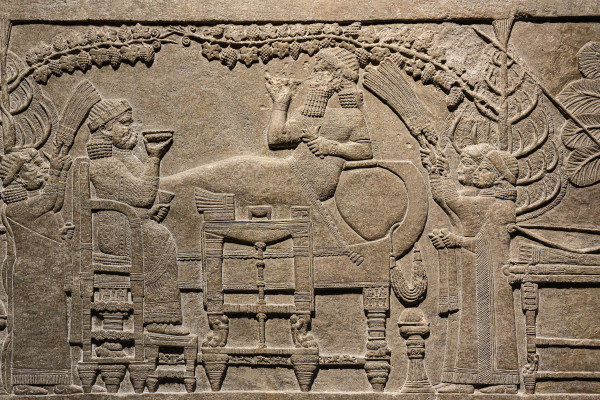
Photo credit: The Royal Banquet of Ashurbanipal in Nineveh. Photo: Allan Gluck – Wikimedia Commons, licensed under CC BY 4.0. Original image and license: Banquet_of_Ashurbanipal_From_Nineveh_Gypsum_N_Palace_British_Museum_03.jpg
Ishtartv.com – History and Heritage
From Nineveh, once the capital of the Assyrian Empire, to Barcelona, a new exhibition revisits the life of King Ashurbanipal, one of the most prominent rulers of ancient Mesopotamia. It highlights the military power of the Assyrian Empire, its rich civilization, and its king's passion for knowledge, learning and writing.
The exhibition, titled "I Am Ashurbanipal, King of the World, King of Assyria," opened on Wednesday, November 18, 2026, at CaixaForum Barcelona and will run until March 29, 2027. It features 158 objects from the collection of the British Museum, presenting the life and historical legacy of the Assyrian king, according to the official exhibition website and the La Caixa Foundation.
Ashurbanipal ruled from 669 to 631 BC, governing the Assyrian Empire from the city of Nineveh, in present-day northern Iraq. During his reign, the empire reached the height of its power and territorial expansion. The exhibition includes stone reliefs that once adorned palace walls, objects documenting royal life, warfare and hunting, as well as artistic works reflecting the development of Assyrian craftsmanship and industries.
Among the exhibits is a small ivory head discovered at Nimrud, dating from between 800 and 600 BC. Its features were blackened by fire, making it an object that bears the marks of time and the destruction that affected archaeological sites across Mesopotamia, according to CaixaForum's description of the exhibits.
The exhibition goes beyond portraying Ashurbanipal as a warrior king, highlighting him also as a ruler deeply devoted to knowledge. In his palace at Nineveh, he assembled a library of cuneiform tablets in an effort to preserve the knowledge available during his era. These tablets have helped transmit a significant part of Mesopotamia's sciences, literature and myths to modern scholars, according to the La Caixa Foundation.
The exhibition once again draws attention to the civilization of Mesopotamia and its enduring contributions to the history of writing, thought, administration and the arts, while emphasizing the importance of preserving its heritage as an integral part of humanity's collective memory.
|