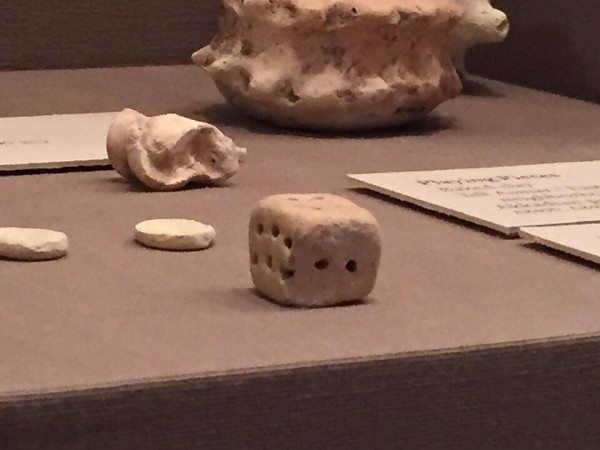
Ancient clay die from Khafajah, dating to the Akkadian period (2350–2150 BC) | Photo: EggsInMyPockets – Wikimedia Commons | Licence: CC BY-SA 4.0
Historical Report – Ishtartv.com
Dice games are among the oldest forms of entertainment known to human societies. Archaeological discoveries in Mesopotamia reveal that games based on chance and the throwing of playing objects were practised thousands of years ago, at a time when games formed part of everyday life. They were not merely a source of entertainment; some were also associated with beliefs, symbolism and social rituals.
Archaeological evidence indicates that dice were known in Mesopotamia during the third millennium BC, approximately 4,500 years ago. This places ancient Iraq among the regions where these objects were used at an early stage, alongside other civilisations of the ancient Near East.
However, the antiquity of dice in Mesopotamia does not necessarily mean that the popular game of Zar, in its present-day form, was played in exactly the same way during that period. There is insufficient evidence to establish the continuity of the game's rules, name and current method of play from ancient times.
Dice in Ancient Iraq
Specialised studies on the history of games indicate that some of the earliest known dice date back to the second half of the third millennium BC. Examples have been discovered in both the Indus Valley Civilisation and Mesopotamia, including cubes bearing markings similar to those found on modern dice.
According to the Assyriologist William Hallo, some dice discovered from this period closely resembled modern dice in shape. Some even featured an arrangement of dots in which opposite faces added up to seven. Dice continued to be used in Mesopotamia throughout the second and first millennia BC, and an example made of glass has also been discovered in Babylon.
Nevertheless, the precise origin of the cubic die remains a subject of scholarly debate. The Metropolitan Museum of Art notes that its origins have not been definitively established, while suggesting a possible connection with the Indus Valley region. It is therefore inaccurate to attribute its invention exclusively to a single people or civilisation.
Games Among the Sumerians and Assyrians
The inhabitants of Mesopotamia played board games in which pieces were moved according to the results of randomised playing devices. Among the most prominent was the Royal Game of Ur, examples of which were discovered in the Royal Cemetery at the ancient city of Ur, dating to approximately 2600 BC.
Archaeological discoveries and research also indicate that the Game of Twenty Squares was widespread throughout Mesopotamia and large areas of the ancient Near East. Game boards and related evidence have been found at Assyrian sites, including Nimrud and Khorsabad, confirming the presence of board games in everyday life, even within royal and military settings.
A study by the Metropolitan Museum of Art explains that some Mesopotamian games spread through trade, military campaigns and contact between different societies. The rules of certain ancient games, however, remain only partially understood to this day.
Dice: A Cultural Legacy Beyond the Boundaries of Civilisations
Dice were more than simple recreational objects. They represented an aspect of everyday social life in the ancient world, revealing the interest of early societies in games, competition and chance, as well as the exchange of everyday cultural practices between civilisations.
Archaeological discoveries in Mesopotamia give Iraq an important place in the history of ancient games, as one of the major centres of civilisation where playing objects and dice were known thousands of years ago.
The origins of Zar in its present-day form, however, remain a subject requiring further historical and archaeological research, free from nationalistic assumptions unsupported by evidence.
|