IshtarTV.com – Alqosh
On the slopes of Mount Alqosh, where rugged rocks meet the traces of prayer and solitude, the Monastery of Rabban Hormizd stands as a witness to centuries of Christian history in Mesopotamia. A landmark that brings together faith, architecture and heritage, the monastery has sustained monastic life across generations, preserving the memory of the Church and its history in the Nineveh Plain.
The monastery is regarded as one of Iraq’s most prominent historic monastic sites. Its origins date back to the seventh century AD, and it is distinguished by its cells and caves carved into the mountainside, its commanding view over the plain, and its historic role in ecclesiastical life. At various points in its history, it became an important patriarchal centre for the Church of the East and later the Chaldean Church.
A Location Where Geography Meets History
The Monastery of Rabban Hormizd is located in northern Nineveh Governorate, near the town of Alqosh, on the slopes of Mount Beth Edhra, also known as Mount Alqosh. It stands approximately 815 metres above sea level, around two kilometres northeast of the town centre.
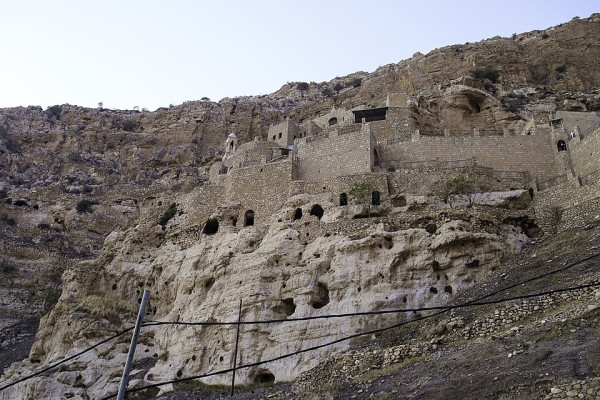
From its elevated position, the monastery overlooks the Nineveh Plain. It is surrounded by a mountain range extending towards the borders of Iraq, Turkey and Iran, creating a landscape in which rugged mountains meet the historic villages and plains of the region.
According to documentation by Mesopotamia Heritage, the monastery’s relatively secluded location, built into a rocky slope, provided a suitable environment for ascetic life, centred on prayer, contemplation and withdrawal from the distractions of everyday life.
Origins Dating Back to the Seventh Century
The beginnings of the Monastery of Rabban Hormizd date back to the seventh century AD, making it one of the oldest Christian monasteries in Iraq. However, its precise foundation date remains a subject of scholarly discussion. Some studies associate its establishment with the period of Patriarch Ishoʿyahb II (628–644), while others suggest that its origins may be even earlier.
The monastery is named after Rabban Hormizd, whose life story recounts that he embraced monasticism after a pilgrimage and spent many years in asceticism and solitude, travelling between monasteries and mountainous areas before settling in the vicinity of Alqosh. His name became closely associated with the monastery, which later developed into a destination for monks and pilgrims.
Religious traditions describe Rabban Hormizd as having lived a long life of devotion and austerity. His spiritual legacy, associated with piety, asceticism and intercession, helped establish his enduring place in the religious memory of the region.
Architecture in Harmony with the Rock
The Monastery of Rabban Hormizd differs from monasteries built on flat ground and surrounded by spacious courtyards. Instead, it appears to form part of the mountain itself. Its buildings are distributed along the rocky slope, with sections integrated into the natural rock formations, while caves and carved monastic cells are scattered throughout the site. These served as dwellings for monks and hermits.
The surrounding area contains a network of rock chambers, some difficult to reach, while others were gradually incorporated into the monastic complex. These cells reflect the ascetic character of monastic life, which relied on solitude, prayer and contemplation in a mountainous environment that offered monks the opportunity to withdraw from the outside world.
The monastery complex includes churches, corridors, rooms and tombs. Among its notable structures is the Church of the Holy Trinity, considered one of the oldest churches within the complex, alongside other churches associated with different stages of its historical development.
A Patriarchal Centre and Guardian of Syriac Heritage
The Monastery of Rabban Hormizd gained particular prominence in Church history after becoming an important patriarchal centre. It was associated with ecclesiastical developments that left a lasting impact on the history of the Church of the East and the Chaldean Church.
One of the most significant events connected with the monastery was the election and appointment of Yohannan Sulaqa, who had been a monk there, as patriarch in 1553. He became the first patriarch of the Chaldean Catholic Church. This event marked a turning point in the Church’s history, amid the religious and political divisions and developments affecting the region at the time.
The monastery was also associated with scholarship and manuscript production. Monks played an important role in copying manuscripts and preserving religious texts. Historical sources refer to written works dating back to the thirteenth century, including a Gospel dated 1208 and a New Testament dated 1222. These records highlight the monastery’s importance not only as a place of worship, but also as a centre of learning and the preservation of written heritage.
Invasions, Destruction and the Loss of Manuscripts
The monastery’s history was not peaceful throughout the centuries. It endured attacks, invasions and looting, as well as earthquakes that necessitated restoration and rebuilding at different periods.
Historical accounts document attacks during the fourteenth and fifteenth centuries, amid Mongol invasions and the campaigns of Timur, which brought instability, destruction and the dispersal of monks.
The monastery also witnessed tragic events during the nineteenth century. In April 1842, it was attacked, resulting in the looting of its possessions and the burning of books and manuscripts. Several monks were reportedly arrested and tortured, according to historical accounts. These records also mention the deaths of the abbot and another monk following torture in prison.
Further losses to the monastery’s manuscript heritage occurred in 1850. Sources indicate that more than a thousand manuscripts were lost. In February 1851, floods reportedly swept away some of the manuscripts that had been preserved at another location, resulting in the disappearance of significant parts of the monastery’s written and historical heritage.
The Monastery of Our Lady of the Seeds: A Continuation of Monastic Life
Amid the difficult circumstances faced by the monks of Rabban Hormizd Monastery, the Church moved towards establishing a new monastery near Alqosh: the Monastery of Our Lady of the Seeds. Its construction was completed in 1858, during the patriarchate of Joseph VI Audo.
The new monastery was established to provide a site that was more accessible and better suited to the needs of monks and visitors. Meanwhile, Rabban Hormizd Monastery retained its historical and spiritual significance as one of the region’s most prominent monastic centres.
The Monastery of Our Lady of the Seeds later became associated with an important Chaldean library, which housed manuscripts rescued from Rabban Hormizd Monastery, thus continuing the work of preserving the Church’s written and religious heritage.
An Enduring Presence in Spiritual Memory
The significance of Rabban Hormizd Monastery extends beyond its architectural and historical value. It remains a place of pilgrimage, prayer and contemplation, attracting worshippers and people interested in Christian heritage and religious archaeology in the Nineveh Plain.
With its surrounding mountain landscape, rock-hewn cells and ancient churches, the site offers visitors an opportunity to discover an important chapter in the history of Mesopotamian monasticism and a way of life in which monks chose solitude and devoted themselves to prayer, in a profound connection with their surroundings.
Among the rocks that sheltered hermits, the churches that witnessed successive chapters in the history of the Church, and the manuscripts that preserved traces of religious knowledge, the Monastery of Rabban Hormizd remains a witness to the ancient Christian presence in Nineveh and to a spiritual and cultural legacy that deserves to be protected and passed on to future generations.