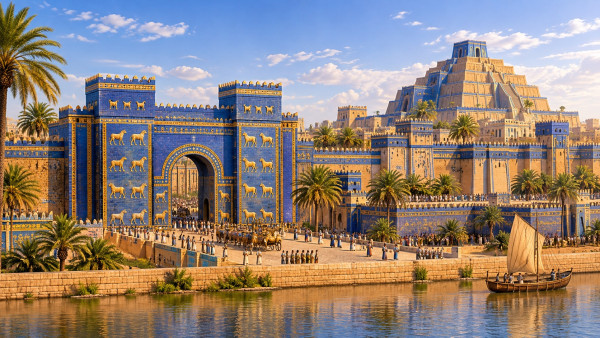
Image caption: Ancient Babylon and the Ishtar Gate, an artistic visualization recreating the grandeur of Babylonian architecture | Image: AI-generated.
IshtarTV.com – History and Civilization
From a land that witnessed the birth of the world's earliest cities, the emergence of writing, and the development of urban organization, as well as early advances in knowledge, architecture, and astronomy, the civilizations of Mesopotamia are finding a renewed presence through the language of modern technology. This effort seeks not merely to recreate ancient stone and clay structures, but to bring back the broader civilizational landscape shaped by thousands of years of human creativity and the enduring relationship between people, land, and rivers.
Building on this rich heritage, engineer Qais Yaqoub Ishaq has undertaken a project to reconstruct historical cities and landmarks of Mesopotamian civilizations using 3D design technology. His work brings together engineering, historical vision, and visual documentation, aiming to recover the appearance of ancient cities, many of which have survived only as ruins and archaeological remains.
Ishaq published his article, Why We Must Recreate the Cities and Landmarks of Mesopotamian Civilizations, in the second 2026 issue of UPLINK Magazine, published by the IEEE Victorian Section and its Tasmanian Sub-section. The article received the magazine's 2026 Special Best Article Award, according to the award certificate dated 19 November 2026.
Fifteen Years of Work to Reconstruct 95 Cities and Landmarks
In a project spanning 15 years, Ishaq states in his article that he has reconstructed 95 cities and landmarks belonging to Mesopotamian civilizations, using 3D design technologies in an effort to recreate the appearance of historical sites and provide visual representations of their urban landscapes during their periods of prosperity.
The project goes beyond reconstructing individual buildings. It seeks to recreate entire urban environments and their various components, including temples, structures, residential buildings, streets, and city walls, as well as the natural surroundings that sustained these ancient settlements. This approach aims to restore a broader understanding of the relationship between people, place, and civilization.
The project draws on the simulation of construction methods and architectural details, using engineering design tools to transform historical information into three-dimensional scenes. These models offer viewers an opportunity to visually explore cities that can no longer be seen in their original form.
The significance of this undertaking becomes particularly evident in light of the disappearance and transformation of historical sites over the centuries. Some ancient cities now exist only as buried archaeological layers or scattered structural remains, making digital reconstruction an important means of recovering aspects of their architectural and urban history.
When Clay Shaped the World's Earliest Cities
The article also revisits some of the environmental conditions that contributed to the development of architecture in Mesopotamia. The region's landscape and the abundance of clay deposited by its rivers played a fundamental role in the evolution of construction techniques, particularly the production of mud bricks, which became a principal building material for houses, temples, walls, and other structures.
In an environment where suitable building stone was not widely available, people developed methods of shaping clay in moulds and drying it under the sun. These techniques transformed a readily available natural resource into standardized building units, helping establish increasingly organized settlements and eventually large cities that became centers of economic, religious, and social life.
Through the reconstruction of these cities, the project seeks to demonstrate how simple materials provided by the natural environment became the foundation of sophisticated architecture, and how the people of Mesopotamia adapted to their surroundings and developed urban solutions that contributed to the advancement of civilization.
Uruk, Eridu, and Tell Khafajah: Images of Cities That Shaped History
The published pages of the article feature three-dimensional models of several historical sites, including Tell al-Sawah, Uruk, Eridu, and Tell Khafajah. These visual reconstructions present imagined views of architectural landmarks, buildings, temples, and streets, while illustrating the extent of ancient cities and their relationship with rivers and the surrounding environment.
The city of Uruk, associated with major developments in Sumerian civilization and the early emergence of writing, and Eridu, one of the region's most historically significant ancient cities, feature among the models that seek to present these settlements as complete urban environments. Rather than limiting the viewer to archaeological remains, the reconstructions offer an opportunity to imagine the nature of life in these cities during their periods of prosperity.
The project also presents visual interpretations of other historical locations, highlighting the diversity of ancient cities, their different urban structures, and the architectural features that reflected the development, needs, and beliefs of their societies.
The value of these models extends beyond their visual appeal. They demonstrate the potential of digital design in historical and archaeological research, education, documentation, and the development of interactive experiences that can introduce ancient heritage sites to a wider international audience.
Technology Does More Than Recreate the Past: It Gives It a New Window to the World
The article emphasizes the importance of ensuring that those involved in reconstructing historical cities possess a sound understanding of their history, environment, and architectural characteristics. Such knowledge helps produce more historically grounded models and reduces the risk of interpretations that are not supported by historical or architectural evidence.
In this context, 3D design technologies offer possibilities that go beyond traditional drawing. They enable the reconstruction of historical sites, the simulation of architectural details, and the presentation of these locations through immersive visual environments that could become part of museum exhibitions, educational programs, and digital platforms.
With advances in artificial intelligence and virtual reality, the possibilities for bringing ancient cities back to life continue to expand. Historical sites can increasingly become digital environments that people can explore, allowing visitors to examine architectural details, learn about everyday life in ancient societies, and experience the settings in which civilizations emerged and developed, leaving a profound impact on human history.
Technology, however, does not replace archaeology or historical research. Rather, it can serve as a supporting tool for documenting, interpreting, and presenting cultural heritage, provided that reconstructions are grounded in available evidence and clearly distinguish established historical facts from hypothetical visual interpretations.
UPLINK Award Recognizes the Article
Qais Yaqoub Ishaq's article received the UPLINK Magazine 2026 Special Best Article Award, according to the accompanying certificate dated 19 November 2026 and issued by the editorial board of UPLINK Magazine, affiliated with the IEEE Victorian Section.
The recognition acknowledges the article's exploration of the reconstruction of Mesopotamian cities and landmarks through 3D design technology. It also highlights the potential of combining engineering expertise and modern technologies with subjects related to history, archaeology, and cultural identity within a publication dedicated to science, engineering, and technology.
Mesopotamia: A Civilization Whose Story Extends Beyond the Past
The reconstruction of 95 cities and landmarks belonging to Mesopotamian civilizations over 15 years of work opens a new window onto a cultural heritage whose details continue to inspire the present and the future. This is a land that witnessed the early development of urban life, humanity's experiments in city-building, the advancement of knowledge, and the emergence of social structures that left a lasting mark on history.
From Uruk and Eridu to the temples, structures, and city walls that witnessed the evolution of ancient societies, Mesopotamia remains a treasure of human history that transcends geographical boundaries. Its heritage deserves to be preserved, documented, and presented to the world through the tools of the modern age without losing its authenticity or historical significance.
Between the clay from which humanity shaped its earliest cities and the digital technologies now bringing those cities back into view, the story of Mesopotamian civilizations continues. It is the story of a land that was not merely a home to the past, but a place from which ideas and innovations emerged, helping shape the course of human development.
Its legacy remains capable of inspiring the future whenever it is rediscovered, its landmarks are brought back into focus, or its ancient cities are digitally returned to life in the collective memory of the world.
|