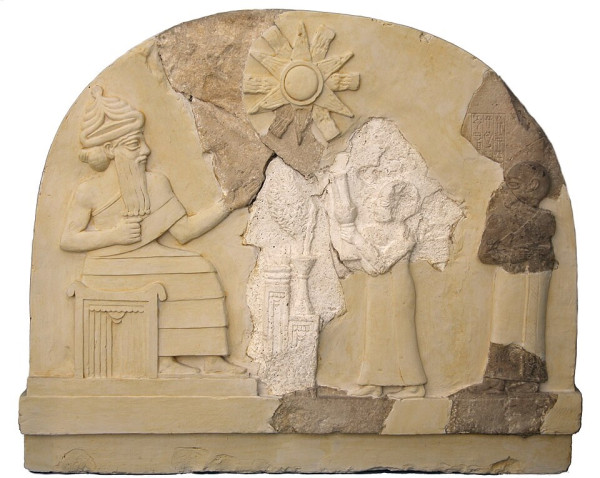
An ancient stela discovered at the Sumerian city of Girsu (Tello), in Iraq’s Dhi Qar Governorate, dating to the Third Dynasty of Ur | Photo: Meskalam – Wikimedia Commons, 20 December 2015 | Licence: CC BY 4.0.
Dhi Qar – IshtarTV.com
In the land of Mesopotamia, where one of humanity’s earliest urban civilizations emerged, archaeological discoveries continue to reveal new chapters in the history of Sumerian civilization. At the ancient city of Girsu, known today as Tello and located in Iraq’s Dhi Qar Governorate, important discoveries have been announced, including a substantial collection of clay tablets inscribed in cuneiform. These findings are shedding new light on the scientific, religious and administrative life of a city that flourished thousands of years ago.
Girsu holds exceptional historical significance because of its ancient origins. Archaeological evidence indicates that the earliest known human settlement at the site dates back to the Ubaid 4 period, approximately 4900–4500 BC, around 2,000 years before the construction of Egypt’s Pyramids of Giza. This does not mean that all the buildings and archaeological remains at Girsu date from that period; rather, the roots of settlement at the site predate the pyramids, while the city developed in later periods into a prominent urban and religious centre of Sumerian civilization.
Discovery of a Sumerian Library Containing Hundreds of Cuneiform Tablets
In a significant archaeological development, the British Museum announced in its 2025–2026 annual report the discovery of an exceptionally well-preserved Sumerian library at Girsu, dating to approximately 1800 BC. The museum described it as a major discovery made during the previous season of the project.
According to the museum, the tablets reveal an active centre of knowledge in which religious rituals, medicine, literature and administration were closely interconnected. They offer valuable insights into the nature of knowledge and how it was recorded and transmitted in ancient Mesopotamian society.
In a related development, the Iraqi News Agency Shafaq News reported on 20 November 2026 that Iraqi tourism and antiquities adviser Amer Abdul Razzaq had announced the discovery of approximately 200 cuneiform tablets inside a building known as the “House of the Priests” or the “Babylonian House”. He explained that some of the texts deal with the Epic of Gilgamesh and the kings of Lagash, while others contain medical prescriptions for headaches, pain and snakebites.
The announcement also referred to the discovery of a rare bronze dagger at the site. These details add to the significance of the British Museum’s announcement about the Girsu library, although the information provided by Iraqi officials should be distinguished from the museum’s own description of its discovery.
The importance of these tablets extends beyond their status as ancient texts. They provide evidence of an integrated system of knowledge, demonstrating how writing was used to record religious and literary traditions, medical knowledge and administrative affairs. They also offer researchers an opportunity to investigate the nature of education and written scholarship in ancient Mesopotamia.
Tombs and Other Discoveries Add to the City's History
The discoveries at Girsu have not been limited to cuneiform tablets. Archaeological work at the site has also uncovered a double burial within an annex associated with a temple in the sacred precinct, dating to the late third millennium BC.
According to the Institute for the Study of the Ancient World at the University of Sydney, the burial context and location differ from known funerary practices in the region. The remains were found in a layer containing thousands of clay balls, a feature that has attracted researchers’ attention and prompted further investigation into the nature and significance of the burial.
Girsu and the Kingdom of Lagash: A Religious and Political Centre in Sumer
Girsu was one of the most important cities of the Sumerian Kingdom of Lagash during the third millennium BC. It was home to a major temple dedicated to Ningirsu, the deity closely associated with the city. It also witnessed important stages of urban, religious and administrative development.
Historical and archaeological evidence indicates that Girsu became a major centre of the kingdom during the Early Dynastic period and flourished particularly under the Second Dynasty of Lagash. One of its most prominent rulers was Gudea, whose reign is associated with significant archaeological remains, sculptures and inscriptions discovered at the site.
Since 2016, the British Museum has resumed archaeological research and excavation at Girsu in cooperation with Iraq’s State Board of Antiquities and Heritage. The Girsu Project combines archaeological excavation, conservation, documentation and the training of Iraqi specialists. Its objective is to reassess the ancient city and understand its urban development, while reconnecting earlier discoveries with their archaeological contexts, following previous excavations that did not always adhere to modern scientific standards.
The project includes research into temples, the administrative centre, water networks and architectural structures, including the Sumerian bridge, which the project describes as one of the oldest known bridges in the world. It also involves documenting and protecting archaeological remains from deterioration and looting.
Iraq: A Land That Continues to Reveal the Secrets of Early Civilizations
The significance of the discoveries at Girsu lies not merely in the number of tablets or artefacts unearthed, but in what they may reveal about the origins of cities, the development of writing, the organization of knowledge, medical practices and state administration in one of the earliest civilizations in human history.
The chronological comparison between the earliest settlement at Girsu and the construction of the Pyramids of Giza also highlights the extraordinary historical depth of Iraq’s archaeological sites. While the earliest known evidence of settlement at Tello dates to approximately 4900–4500 BC, the Great Pyramids of Giza were built around 2,000 years later.
Among layers of clay, ancient remains and cuneiform inscriptions, Girsu continues to preserve evidence of a Sumerian world that left a lasting mark on human history. Its ongoing discoveries demonstrate that many chapters of Mesopotamia’s past remain unexplored, while protecting these archaeological sites and supporting scientific excavation represent a cultural and historical responsibility extending far beyond Iraq’s borders.
|