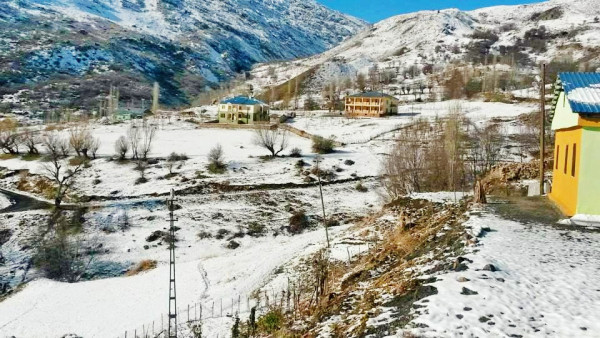
The Chaldean village of Gaznax in the Mount Judi region of Şırnak Province, southeastern Turkey, during winter | Photo: Meganesia – Wikimedia Commons, 17 July 2018 | Licence: CC BY-SA 4.0.
IshtarTV.com – Historical and Documentary Study
Among the mountains of the Judi region in southeastern Turkey, the village of Gaznax (Gaznakh / Geznakh) holds a special place in the history of ancient Christian settlements. Its name is associated with the Syriac, Assyrian and Chaldean presence in the Şırnak region and the historical province of Hakkari, as well as with the modern Aramaic language passed down by its inhabitants through generations.
The significance of Gaznax extends beyond its identity as a historical home to Christian mountain families. It also represents a social, religious and linguistic heritage that deserves renewed examination in light of foreign historical records, particularly British reports documenting the geography of Kurdistan and its Christian communities in the late nineteenth and early twentieth centuries.
A review of the available references highlights the need to distinguish between two types of evidence: contemporary British records relating to the village and its surrounding region, and later academic studies documenting Gaznax's history, dialect and heritage. It is important to note that, so far, no published British document has been identified that can be cited as definitive direct evidence of the village's name. Therefore, detailed information about Gaznax should not be attributed to the British archives without locating the original text.
1. Gaznax: Its Geographical and Historical Location
Gaznax is located within the Beytüşşebap district of Şırnak Province in southeastern Turkey. Its present-day administrative name is Cevizağacı.
The village appears in specialized studies under several spellings, most notably Gaznax, Gaznakh and Geznakh. These variations reflect different ways of transliterating the local name into the Latin alphabet and do not necessarily refer to separate villages.
Linguist Ariel Gutman, in his 2015 academic study entitled Some Features of the Gaznax Dialect (Southeast Turkey), identifies Gaznax as the local name of a Chaldean village in Şırnak Province. He describes it as one of eight Chaldean villages in the region, whose dialects share a number of linguistic features belonging to Modern Aramaic.
This academic reference is particularly significant because it documents the village's local name, ecclesiastical affiliation and linguistic identity, placing it within the historical geography of Christian communities surrounding Mount Judi.
2. What Do British Records Reveal About the Region?
One of the most important British references for understanding the historical and geographical environment to which Gaznax belongs is a book by British military officer Lieutenant F. R. Maunsell, published in 1890 under the title:
Reconnaissances in Mesopotamia, Kurdistan, North-West Persia, and Luristan from April to October 1888.
The work was published through the Intelligence Branch of the Quartermaster-General's Department of the British Indian military administration. It presents the findings of reconnaissance journeys conducted in 1888 across parts of Mesopotamia, Kurdistan and northwestern Persia.
On page 146 of the printed edition, Maunsell describes the distribution of Christian and Chaldean villages in several areas. He refers to Chaldean villages in the Sapna Valley, northeast of Amadiya, and also mentions Christian communities in other regions, as well as Chaldean monasteries, churches and religious centres.
The report states that some villages in the Sapna Valley were Chaldean, while others were ecclesiastically affiliated with Mar Shimun. It also discusses Christian villages in the areas surrounding Zakho, Amadiya and the Khabur region.
This account is important for understanding the geographical distribution of Christian communities in Kurdistan during the late nineteenth century. However, it does not mention Gaznax by name on the cited page and cannot be treated as direct evidence of the village's population, churches or administrative status at that time.
Original document: Qatar Digital Library – Maunsell's British report, 1890, page 146.
3. Churches, Monasteries and Religious Heritage
Gaznax preserves an ecclesiastical heritage extending back centuries. Historical references dealing with Assyrian and Chaldean communities in the Hakkari region point to the existence of several religious sites in the village and its surroundings.
Among the sites mentioned in these references are:
-
Monastery of Mar Yohannan (St. John).
-
Church of Mar Ishaya (St. Isaiah).
-
Church of Mar Gawsa.
-
Church of Mar Shimoni (St. Shmuni).
-
Church of Mar Gabriel.
This list suggests that religious life in Gaznax was not centred on a single church, but was associated with several places of worship reflecting the deeply rooted ecclesiastical and social presence of its inhabitants.
Some references state that the village's inhabitants historically belonged to the Church of the East, before communities during the twentieth century turned towards the Chaldean Catholic Church and the Syriac Orthodox Church to meet their spiritual and ecclesiastical needs.
It is important not to confuse historical church affiliation with national and cultural identity. The history of the region reflects a diversity of ecclesiastical affiliations within the broader Syriac, Assyrian and Chaldean community.
4. The Chaldean Language: Gaznax's Heritage Beyond the Village
One of Gaznax's most distinctive features is its preservation of a particular dialect of Eastern Modern Aramaic, known in linguistic studies as the Gaznax Dialect.
Researcher Ariel Gutman devoted an academic study to this dialect, published in 2015 as part of the volume:
Neo-Aramaic and its Linguistic Context.
The study examines the dialect's phonological, grammatical and linguistic characteristics, as well as its place among the dialects of the Mount Judi region.
Gutman also explains that the village was one of eight Christian settlements in the region whose inhabitants spoke closely related dialects. The distinctive features of the Gaznax dialect are connected to the village's geographical location and the historical interaction between Christian mountain communities.
This linguistic heritage gives Gaznax significance beyond its geographical boundaries. It represents part of the linguistic legacy of our people and illustrates the diversity of Aramaic dialects preserved by Christian villages in the historical regions of Kurdistan.
5. Social and Economic Life in Gaznax
The lives of Gaznax's inhabitants were closely connected to the mountainous environment. Families traditionally relied on agriculture, animal husbandry and activities associated with the local natural landscape.
Historical information published about the village indicates that it had approximately 100 families during the second half of the nineteenth century. This figure, however, is based on secondary historical references rather than a direct British census document identified to date.
Data collected by German researcher Rüdiger Benninghaus on Chaldean villages in Turkey also records population figures for Gaznax during the second half of the twentieth century:
| Year |
Population |
| 1975 |
241 |
| 1985 |
286 |
| 1990 |
120 |
These figures indicate significant demographic changes in the village during that period, before its population was further affected by waves of migration and displacement.
6. Migration and Return to the Village
Like several other Christian villages in the Judi and Şırnak regions, Gaznax experienced major demographic changes during the final decades of the twentieth century.
Linguistic studies indicate that inhabitants of the eight Christian villages in the region were forced to leave their homes around the beginning of the 1990s because of political and security conditions. Meanwhile, Benninghaus's data indicates that the last Christians left Gaznax in 1988.
The village, however, differed from some neighbouring settlements in that a number of its former inhabitants eventually returned. Gutman notes that residents began returning and resettling in Gaznax from 2004 onwards.
This development reflects the families' enduring connection to their ancestral land and their desire to maintain their ties to their historic homeland despite years of absence and migration.
7. Gaznax in Contemporary Memory: A Book Preserving the Village's Story
Among the important works documenting Gaznax's history and its social and cultural memory is the book:
Gaznakh: Nid des Civilisations – Gaznax: Nest of Civilizations
Written by Zackarie Yaramis and published in French in 2010, the book explores the village's history, the lives of its inhabitants, their customs and traditions, as well as their popular and religious heritage and social ties with neighbouring Christian villages.
In an interview published by Ninway Magazine in 2016, Yaramis discussed the motivations behind writing the book. He explained that he wanted to preserve the memories of previous generations, document the village's social and cultural life, and pass its history on to future generations.
The book represents an important source for completing the historical picture that administrative and military reports alone cannot provide, as it conveys aspects of the local memory experienced and passed down by the village's inhabitants.
Gaznax: The Importance of Documentation Through Archives and Memory
The history of Gaznax demonstrates the importance of combining British records, academic research, historical maps and local accounts in order to develop a more complete understanding of the Chaldean villages of the Mount Judi region.
Nineteenth-century British documents provide information about the region's geography, Christian communities, churches and monasteries, while modern linguistic and historical studies offer more specific details about Gaznax's name, dialect, population and ecclesiastical heritage.
Further research is still needed in the archives of the British Library, particularly the India Office Records, as well as in reports by British travellers and military officers and historical military maps, in order to identify any direct reference to the village under its various spellings: Gaznax, Gaznakh and Geznakh.
Preserving Gaznax's history is not simply a matter of recalling the name of a mountain village. It is an effort to document part of the history of our Chaldean Syriac Assyrian people (Suraya), and the memory of communities that preserved their language, churches, traditions and identity across generations.
|